How the Decline of Labor Power and the Rise of the Knowledge Class Reshaped American Politics
The Democratic Party’s loss of the working class is usually explained as a problem of ideology, messaging, race, education, or cultural resentment. I argue that the deeper problem is organizational. Over the past half-century, workers have lost the autonomous institutions that once allowed them to bargain collectively within the party, while academia and the wider knowledge class have gained greater influence over its language, priorities, and candidate-selection process.
To explain how this happened, this essay begins by briefly touching on the way human beings pursue self-interest and status and how power is organized within societies. It then draws a historical organizational parallel between the modern knowledge class and the medieval Church, examines the political importance of unions, and argues that the McGovern-Fraser reforms fundamentally changed the Democratic Party by weakening labor and other durable organizations within it. The reforms also provide a useful point of comparison, allowing us to examine why the candidate-centered primary systems that both parties eventually adopted are fundamentally worse than the convention-based system they replaced.
Finally, the essay discusses the real grievances of the working class before turning its attention to the Right, examining how populism functions in America, how Trump captured the GOP by harnessing its “latent populist energy,” and the role conspiracy theories play in right-wing populism. It then concludes by laying out the broader problem facing American politics while offering a path forward.
In this essay:
- Elite power and open-access institutions
- American populism, academia, and the knowledge class
- The New Deal, organized labor, and Democratic Party reform
- Working-class decline and Right-wing populism
- Trump, conspiracy politics, and the American Right
- Conclusion
Elite Power and Open-Access Institutions
Humans are naturally illiberal. We care much more about the interests of ourselves, our families, and our coalitions (usually in that order) than the interests of strangers. In fact, if we are to believe history, we often actively harm strangers to advance our own interests and those of our coalition. Of course, we can also be cooperative with strangers, too, but rarely does it not ultimately serve our own self-interest.
Elites, then, are unusually good at turning human self-interest into organized power. Ordinary people may want more resources for themselves and their group, but it is the elites who are uniquely capable of large-scale coordination and who occupy positions of high leverage (resources, institutions, military power, etc.). This makes them and their self-interest very dangerous. If they believe the existing order no longer serves them, they can, and often will, destabilize society itself. And being powerful, large-scale organizers, they have no problem committing mass, sustained violence and destruction to get what they desire. When Alexander Hamilton wrote about Pericles, Cardinal Wolsey, and the “bigotry of one female” in The Federalist Papers, this is what he is describing.
“The celebrated Pericles, in compliance with the resentment of a prostitute, at the expense of much of the blood and treasure of his countrymen, attacked, vanquished, and destroyed the city of the SAMNIANS. The same man, stimulated by private pique against the MEGARENSIANS, another nation of Greece, or to avoid a prosecution with which he was threatened as an accomplice of a supposed theft of the statuary Phidias, or to get rid of the accusations prepared to be brought against him for dissipating the funds of the state in the purchase of popularity, or from a combination of all these causes, was the primitive author of that famous and fatal war, distinguished in the Grecian annals by the name of the PELOPONNESIAN war; which, after various vicissitudes, intermissions, and renewals, terminated in the ruin of the Athenian commonwealth.
The ambitious cardinal, who was prime minister to Henry VIII., permitting his vanity to aspire to the triple crown, entertained hopes of succeeding in the acquisition of that splendid prize by the influence of the Emperor Charles V. To secure the favor and interest of this enterprising and powerful monarch, he precipitated England into a war with France, contrary to the plainest dictates of policy, and at the hazard of the safety and independence, as well of the kingdom over which he presided by his counsels, as of Europe in general. For if there ever was a sovereign who bid fair to realize the project of universal monarchy, it was the Emperor Charles V., of whose intrigues Wolsey was at once the instrument and the dupe.
The influence which the bigotry of one female, the petulance of another and the cabals of a third, had in the contemporary policy, ferments, and pacifications, of a considerable part of Europe, are topics that have been too often descanted upon not to be generally known.”
Limited-Access Orders and Elite Power
For most of recorded history, large-scale societies have formed what are called limited-access orders to address this problem of elite violence. They are not consciously formed but more like ‘natural states’, recurring patterns across history. Any time you think of a medieval kingdom or empire, you’re thinking of a limited-access order. These societies solve the problem of violence by giving elites ‘rents’: special privileges over parts of the economy and society. This incentivizes the elites to support the society rather than destabilize it. To varying degrees, North Korea, China, Russia, Saudi Arabia, and Iran are examples of modern-day limited-access orders.
Open-Access Orders and American Political Development
Open access orders, on the other hand, are very rare. They are “unnatural states” (my phrasing). They are societies in which political and economic rights are broadly available rather than specially reserved for rent-seeking elites. It is extremely difficult, if not impossible, to move from a limited-access order to an open-access order because the elites have too much incentive to keep things closed. Any attempt at transition poses an existential threat to them. True full transitions, therefore, always require some exogenous shock and/or rupture to the system.
The first major exogenous shock that set the United States on its path to becoming an OAO was the Seven Years’ War, which greatly expanded Britain’s territory and created a large war debt. This led Britain to impose new imperial policies and taxes upon the colonies, causing resentment among colonists who increasingly questioned Parliament’s authority over them. The imperial crisis then eventually led to the Revolutionary War, the rupture.
The Three Doorstep Conditions for Open Access
There are three doorstep conditions in the creation of an open access order. They are as follows:
- Rule of law for elites
- Perpetually lived organizations in the public and private spheres.
- Consolidated political control of the military
For America, our doorstep conditions were fulfilled as follows:
- Elite factions had relatively secure property rights, courts, contracts, legislatures, and constitutional guarantees.
- Instead of a king’s familial household, America was built around state governments, Congress, courts, colleges, banks, corporations, political parties, etc. These could persist across generations, allow for impersonal exchanges, and turn elite competition into institutional competition.
- The Constitution strengthened national control over war-making, taxation, and military regulation, but remained partial (this is true for 2 as well) until after the Civil War.
Many of the conditions for an open access order already existed in Britain and were inherited by British America, becoming more explicit through the Constitution. However, the institution of slavery created a significant problem for the United States’ claim to being a truly open-access order. By protecting slavery in the Constitution, the framers in essence set up an economic and political rent for the slaveholding elite, whilst simultaneously denying a third of the South’s population any rights whatsoever — it being the only condition upon which the slaveholding elite would accept joining the Union.
This created a strange society; a limited-access regional order embedded inside a partly open-access national constitutional order. That made the South progressively more like a rival state, unfairly seeking more political and economic extraction from its ‘neighbor’. The Civil War, therefore, can be understood as the rupture between two rival claims over the future shape of America: whether the slaveholding, limited-access order would be protected and allowed to expand, thereby tilting the national order further in its illiberal direction, or whether it would be contained by the Union. In retrospect, containment ultimately meant the institution’s total destruction, as any other result would have simply calcified into another closed, elite-controlled society.
The collapse of the antebellum South was the true beginning of the United States’ march to being an open-access order, as the slaveholding elite’s grip over the South had been demolished. I examine the conflict over slavery’s expansion and secession more fully in my essay on the Union, the South, and the Civil War.1
How Open-Access Orders Differ from Democracy and Open Markets
It can be easy to conflate open-access orders, democracy, and open markets. But a society can have competitive elections and still distribute access to land, offices, and markets through castes, kinship, or clans. Likewise, it can have a decentralized market system and still be controlled by elites.
For example, India is a democracy, but it is still a limited-access order. The elections are real. Governments lose and accept defeat. But many of the regions are controlled by hereditary caste blocs and party patronage networks that mediate access to land, government contracts, and markets. They differ from the US’s political and economic system, which is generally impersonal and more widely available through formal legal rules. This is why parties can radically change coalitions and ideologies over time in America. The Democrats were both the slaveholding and the Civil Rights party.
Open markets are ancient social and economic technologies. They serve a genuinely irreplaceable function in every society: they coordinate real prices, exchange, and specialization. A king, queen, or even a glorious leader cannot do this effectively on their own. However, in limited-access orders, regulation is not carried out through objective measures but through rent mechanisms.
Why Impersonal Institutions Matter
However, in the US, you could still argue that elites use rent mechanisms here, too. That is correct. They do. Humans are naturally illiberal, and elites with disproportionate power will inevitably seek rents from society, no matter its organization.
The difference lies in the governing standard. Open-access orders establish an enforceable expectation of impersonal access, even though that standard is frequently violated. Major rent-seeking, therefore, tends to be conducted through formal institutions: elites buy access to the rule-making process rather than simply purchasing personal favors from state officials.2
This matters a lot as it makes attempts at institutional capture more visible, contestable, and (sometimes) reversible. Limited-access orders, despite their pretensions to impersonality, allow direct state access through personal relationships, heredity, and membership within privileged networks.
As a funny example to show you what I mean, take these two scenes: one from Horrible Bosses, the other from Steve Jobs. You don’t have to watch the clips, but they do show the difference quite cleanly.
In Horrible Bosses, Colin Farrell’s character Bobby Pellitt, a dipshit cokehead, inherits his business from his dad, becoming its boss. Because it is a private company, he does not have to answer to anyone; he is its de facto leader. He is also a dipshit cokehead. To him, the company represents nothing but a rent.
No fucking shit, I don’t care about this company! What you-you, this is just an ATM to me!
In an impersonal system, Jason Sudeikis’s character would likely be the company’s boss, but heredity won out.
In Steve Jobs, Steve Jobs and John Scully argue about the board’s decision to fire Steve from Apple. Steve Jobs (alongside Wozniak) is the closest you can get to having a hereditary right to the company. But because of the company’s specific organizational structure, it acted in an impersonal way, firing him once he was seen as a threat to its success.
THE SHAREHOLDERS ARE MY PROBLEM, AND THE BOARD REPRESENTS THE SHAREHOLDERS; THAT’S HOW IT WORKS!
Whether his firing was right or wrong is not the point. The point is that Jobs could not claim a natural right to the company he created (alongside Wozniak). Even Sculley’s motivation for ousting Jobs could be construed as personally political, but he could not just fire him on his own. He had to navigate the board and provide Jobs procedural recourse. That makes it impersonal.
Obviously, these are companies, and they exist within a larger framework3, but the structure scales. The ‘Bobby Pellitt model’ at the state level is the family dynasty that treats the national treasury as inherited property, i.e., the Kim Dynasty.4 The ‘Apple Model’ is a court ruling against a beloved president.
How Elites Convert Cultural Status into Power
Elite status throughout history is most usually associated with gentility. Japanese Samurai elites, European aristocrats, Chinese mandarins, and the antebellum planter class all share this quality. Objectively, all brutal societies, sure, but the manners the elite adopted were harmonious, refined, and often high-cost and mechanically useless. This serves a specific ideological purpose: It naturalizes hierarchy. If the elites are more cultivated, morally righteous, more restrained…well…shouldn’t they rule, after all?
The social order appears to be a natural order. This is what makes it old money or cultural status. It persists generationally and cannot be achieved solely with money. If you’ve read The Great Gatsby, Wuthering Heights, or Gone with the Wind, the difference between Gatsby, Heathcliff, Emmie Slattery, and aristocratic society—even after they acquire mass wealth—is cultural status.
There’s an interesting psychological effect underneath this. Elites (like everyone else) in society will surveil themselves until they eventually internalize these cultural and moral signals. Some may call this the ‘super ego’ and the internalization process the “super ego collapsing into the real ego”, or something, but there’s no need to use such pretense.
Instead, imagine you’re a twelve-year-old kid from a small town in a flyover state in the 90s. One day, your dad accepts a job offer in the city for much better pay, but taking it means your family has to relocate. Suddenly, you’re in a new place where everyone dresses differently, talks differently, and maybe even walks differently. The signals of this new environment/culture are foreign to you. You should start to feel anxious about your first day at your new school. What was normal back in your old town of 50,000 people could now be construed as weird and off-putting. And middle schoolers are very, very good at recognizing weird and off-putting signals.
So on your first day, you are quiet. You watch everyone nervously trying to understand the way they ‘work’. Then you have your first conversation. You should be careful about the way you conduct yourself. Every move is a potential weapon, and beneath all their pleasantries, if they’re pleasant at all, they’re watching you. Feeling you out. So you watch this person, too. You observe their facial movements for the most minute details. If they furrow their eyebrows half an inch when you make a ‘weird’ gesture, you clock it. And then you begin to surveil yourself, making sure the gesture does not appear again. When it’s their turn to talk, they might mention their favorite music. You clock that, too. Does everyone at this school like this music, or is it just this person? Maybe at PE, you hear a group of kids raving about the same exact music. Ah, now you know.
When you go home, you’ll listen to the music, learn all you can about it, and begin to argue with yourself. Eventually, you’ll come to a decision that while you still prefer country, this Radiohead stuff is actually pretty good, too!
Then, as the days march on, you’ll continue to monitor your gestures, continue to monitor the way you talk about the newfound love you have for Radiohead (or at least hide your disdain for it) until by the end of the semester, you won’t have to monitor anymore; you’ll just get it. You’ll still be you, still have your accent; you just become fluent in their language. The higher the stakes, the more fluent. And this can also work in the opposite direction, too. Maybe you can talk about everyone’s favorite music better than they can. Now you’re moving up in the world.
The argument, monitoring, and reflection you are engaging in is one of the major pressures (if not the pressure) that shaped our consciousness. It’s an intricate, reciprocal process of perception, ‘mind reading’, and emotional regulation, all structured through language. You are trying not to be found out. That could mean low status, or even worse, an out-group member. So, like a fighter who has practiced a single kick ten thousand times, at first with conscious methodical deliberation, you, too, ‘practice’ this new culture until eventually, you just do it.
And what’s more, if you stay in the city and your Radiohead fluency impresses a mate so much they end up marrying you, your eventual kid won’t have to learn any of the signals you struggled so hard to obtain; they’ll just see it as the natural order of the world.
The only difference for elites is that the gestures are harder to master. They require a lot of time and effort and are very difficult to fake. If they are useless, even better. A lower-class person will struggle to get past the monitoring stage. Their gestures will get ‘stuck’ in a conscious, awkward way, making them easy to spot.
American Populism, Elite Power, and the Knowledge Class
The illiberal turn we see today is in many ways harder to define than in the past. Because of the impersonal, mature structure within the US, there is no real ‘this revolutionary power vs. this state power’. For instance, the Bolsheviks were definitely the revolutionaries against the Provisional Government’s state. The CCP was definitely the revolutionaries against the KMT state. Both were large elite coalitions fighting for dominance over their respective societies.
Of course, if we were to speak crudely, the Conservative Party is the low-hanging fruit in our current story. Trump is often just one question away from outright saying, “No fucking shit, I don’t care about this country! What you-you, this is just an ATM to me!”
He is unpretentious in his aims. And the political and media elite that follow him are unpretentious in theirs. But we should try to be more sophisticated in our assessment.
Academia, Cultural Status, and the Knowledge Class
Academics, for the most part, cannot accrue wealth in the same manner that those in the private sector can.5 But they can accrue cultural status. They are genteel in much the same way elites of the past were: Refined, cultivated, and moral. And because academic work is almost entirely symbolic, language becomes both the medium and the substance of status competition within these institutions.
This is not inherently bad. In fact, most of the time, it is quite good. Like anything else, properly directed intense competition is necessary to produce novel and useful ideas. Refinement, restraint, and even strong moral beliefs are all qualities that help structure institutions and one’s own cognitive engine to resist bias and motivated reasoning.
But evolution is a clever beast, and not even the most brilliant among us escape its grasp. Natural selection did not design our minds to pursue abstract concepts such as scientific theories, mathematical principles, or justice and truth as ends to themselves.
Therefore, it is easy for language and beliefs used to display intelligence, refinement, and moral seriousness to take on a secondary function beyond the ideas it is trying to communicate. Because these qualities are difficult to measure directly, institutions must rely on recognizable signals of them. Over time, fluency in the accepted language becomes one of those signals.6
The problem is that it becomes hard to distinguish the signal from the underlying quality it represents. A sophisticated vocabulary may show true sophistication, just as moral language may show true moral conviction. But once it becomes culturally embedded and institutionally incentivized, it also becomes a tool of status competition. Members learn that a particular language denotes a person as high status, while departing from that language increasingly denotes a person as low status or an out-group member.
None of this has to be cynical, by the way. A person can both sincerely believe in something and be evolutionarily incentivized to hold that belief. And once high-status institutions use it as a threshold for determining who belongs and who advances, and their members reward certain moral convictions, it becomes the way aspiring elites must think and conduct themselves in order to advance.
The Medieval Clerical Class and Institutional Power
With the collapse of the Western Roman Empire, demand for literacy declined sharply. Rome’s administrative machinery no longer existed, and the bureaucratic class that sustained it disappeared. As a result, literacy in Western Europe contracted heavily into the hands of the Church. This gave the Church a near monopoly over every domain of social activity that required written communication.
The educated officials of the Church—meaning priests, bishops, monks, scribes, ecclesiastical administrators, etc.—were collectively known as the clerical class. This was an internally stratified but collectively high cultural status class.
The concept of the Three Estates, rooted in medieval European society, delineated a hierarchical structure comprising distinct social classes: the clergy, the nobility, and the commoners. This tripartite division, which emerged during the Middle Ages, profoundly influenced political, economic, and cultural dynamics for centuries. The clergy, consisting of religious leaders and institutions, held spiritual authority and wielded significant influence over both the ruling elite and the masses.
Because clergymen held high cultural status, they were granted special privileges. For example, they could be tried only in ecclesiastical courts, and offenses committed against them by laymen would also fall under Church jurisdiction.
The Church was also the dominant patron of art during this period, dictating its themes and style. Religious art thus displayed the Church’s divine authority and cultural power.
More importantly, the Church held absolute leverage over salvation. This operated through what became the seven sacraments: baptism, Eucharist, confirmation, reconciliation, anointing of the sick, marriage, and ordination. Each of these sacraments required a validly ordained priest, creating a cradle-to-grave structure. There was no way to exit this system and remain a Christian in good standing within society.
The system was reinforced by a theological concept called ex opere operato. The sacraments gained validation “from the work worked,” meaning grace flows from the administration of the sacrament itself, not the individual holiness of the person administering it. In this view, corrupt priests could administer valid sacraments, but a saintly layman could not, consolidating spiritual power further in the Church.
Church texts, like the Bible and canon law, along with many written legal and administrative procedures, were written in Latin, making the Church’s role within society even more indispensable, as spiritual and procedural life could not proceed without its authority and direction.
The first major complete English Bible, for instance, did not appear until the late 14th century. It is important to keep this timing in mind as we discuss the Black Death, the Western Schism, and the anticlerical movement that occurred just before this Bible was produced. It is also important to remember the name of the man whose movement gave rise to it: John Wycliffe. Wycliffe, along with his followers, the Lollards, was a significant part of the broader anticlerical movement and a precursor to the Protestant Reformation. He deserves a section of his own, so we’ll return to him later.
The interdict was the most powerful expression of institutional leverage the Church had and probably the most powerful in all of medieval history. When the Church invoked an interdict, all Christian-marked activities were suspended in the kingdom (with partial exceptions). This allowed the Church to apply immense pressure on a ruler by weaponizing the populace’s spiritual anguish against them.
The interdict of 1208 is an instructive case. When Hubert Walter, Archbishop of Canterbury, died in 1205, three parties immediately tried to claim the right to appoint his successor. They were:
- The Canterbury Cathedral monks
- The bishops of the province of Canterbury
- King John
The first and second matter most here. Archbishop Walter was attached to Canterbury Cathedral and, under church law, they normally had the right to elect the bishop or archbishop. However, King John claimed that because Archbishop Walter held major lands from the Crown and played a central role in government, any decision should instead require his consent.
Behind the king’s back, the Canterbury Cathedral monks secretly elected their sub-prior, Reginald, and sent him to Rome to receive confirmation from Pope Innocent III. The secret was then made public. King John, angry that he had been undercut, pressured the monks to elect John de Gray, Bishop of Norwich, a royal servant and loyalist to him.
Innocent rejected both elections. In Reginald’s case, he argued that the election had been conducted “uncanonically and clandestinely”; in other words, its secrecy made it defective. In John de Gray’s case, he argued that de Gray had been elected before the pope had formally resolved Reginald’s case, also making it defective.
Innocent then “recommended” the monks elect his man, Stephen Langton, and with no other choice, the monks did (it was also a favorable consolation for them). This allowed Innocent to clean up the messiness of the monks’ defective election while installing a learned churchman who would not be controlled by King John, maintaining Church independence and papal authority.
Obviously, King John was not too happy about the decision. He refused to allow Stephen Langton to enter England or take possession of Canterbury lands. He also punished the Canterbury monks for cooperating with Innocent, driving them into exile and seizing Church property.
So Innocent retaliated by invoking an interdict.
The interdict of 1208 severely disrupted spiritual life in England and Wales and caused widespread panic amongst the masses. King John responded aggressively, further punishing the clergy class and confiscating more property.
Then, in 1209, Innocent excommunicated King John. A king’s rule is given authority under God, and now King John was isolated, putting immense pressure on him. Since he was excommunicated, the French, with whom he was in conflict, could be given papal authority to invade England.7
And, to be clear, if France invaded England, they would not have told the peasants, “We’re not here for you—we only want your king! Huzzah!” They would have treated the population as fair game, killing, raping, looting, and terrorizing whoever stood in their way.
Feeling the walls closing in, King John capitulated totally.
Over time, the authority of the Church and the pope declined as kings began to call the Church’s bluff. They increasingly treated the interdict as an inconvenience rather than an existential crisis. Respect for Church authority withered so dramatically that in 1302, when Pope Boniface VIII issued Unam Sanctam—an extreme declaration that submission to the pope was necessary for salvation—Philip IV of France, angered by a dispute over taxing the clergy, had the pope physically seized and humiliated.
The Black Death then caused the masses to further question the Church’s authority. If the clergy and priests were holy, why were they not protected from the disease? Why were they dying in such enormous numbers? Why were the devout dying alongside the wicked? The irony, of course, was that many clergy died precisely because they stayed behind to care for the sick. Yet even so, it was those who fled their duties who shaped the image of a priest. They were seen as failures; selfish cowards saving their own skin at the expense of the common man’s soul.
And because the Black Death killed an enormous number of clergymen, the Church had to lower its standards in an effort to replace the dead, the thought being “they would be better than nothing”. This produced a wave of underprepared and often clumsy priests. These new priests had not been given enough time to internalize the Church’s moral and spiritual discipline, making their claims to holiness easier for the masses to see through. Any greed, corruption, or incompetence they displayed was no longer hidden behind the aura of sacred authority; it was plain to see. Ultimately, the erosion of the Church’s credentialing system, combined with the authority still granted to under-qualified clergy, fueled resentment among the masses.
This gave rise to anticlericalism and the flagellant movement.
The Black Death saw the rise of the flagellant movement, in which groups of men and women publicly flogged themselves while preaching a radically deinstitutionalized form of Christianity, incurring the condemnation by the Church but ultimately exposing its weakness. Heretical sects of Christianity proliferated in Western Europe, and while not all of these were as zealous as the flagellants, they shared a conviction that the Church was failing in its essential purpose. Antisemitic violence also increased as Christians sought a scapegoat to blame for the spread of the disease. Although the Church condemned this activity, the persistence of violence against Jewish people revealed deeper fractures in its ability to control or assuage the congregation.
Sound familiar? It continues:
As the Church was the wealthiest and most politically powerful institution throughout the Middle Ages, it became a focal point for accusations of decadence, corruption, and hypocrisy after the Black Death. The mendicant orders (Franciscans, Dominicans, Carmelites, and others) had proliferated since the early thirteenth century, and by the late-fourteenth century they became subject to increasing scorn and vilification. Criticism of friars, the papacy, and the institutional Church was known as “anticlericalism,” and anticlerical literature became a popular genre of complaint. Friars received especially vicious attacks, as they relied on charitable donations for their living and were reputed to take alms greedily and indiscriminately, amassing small fortunes for themselves whilst neglecting the spiritual welfare of the larger community.
As an example of the growing, sustained popularity of anticlericalism, the second-most-popular Christian text in Western Europe during the fifteenth century was The Imitation of Christ by Thomas à Kempis. It’s hard to overstate its popularity for its time. A modern comparison might be Harry Potter at the height of its release, except that The Imitation of Christ reached across nearly every demographic and maintained its popularity for roughly two centuries. The book was a subtle, indirect challenge to Church authority, simply holding up Christ’s life as the model for true Christianity: poverty, humility, indifference to honor and status, and inward devotion. The reader was then left to draw the obvious conclusion.
The final event we should discuss before moving forward is the Western Schism. It began less than three decades after the Black Death, meaning the plague and its aftermath were still fresh in the memory of those now witnessing the Church split against itself.
The Western Schism, greatly truncated, was a dispute that began in 1378 between two men who both had legitimate claims to the papacy. Because they were both legitimately elected, there was no way to determine who should ultimately assume the role. The only way to fix this problem was to try to convene a council with supreme authority to make the final decision.
The only problem is that would directly contradict the very theology that made the pope the supreme authority. So, as a result, the question was effectively left to secular rulers.
What happened next exposed the Church and the state’s true colors.
France supported the French pope. England, at war with France, supported the not French Roman pope. Scotland, allied with France, supported the French pope. Other rulers chose sides according to their own interests and alliances. Political self-interest, not moral principle, dictated their choices. And with resentment from the Black Death still viscerally felt and anticlericalism well on the rise, the Church’s universal moral authority collapsed before the people’s eyes.
Note: Church institutions are the ancestors of university institutions. A trap one may fall into is assuming there is a direct line from Church religious ideology to university secular ideology. Resist that temptation. There is no doubt of overlap, since we are a nation shaped by Christian morality. But it is better to look at each institution’s position within the wider structure of society, and at how incentives shape ideological formation from within that position. The similar patterns emerge, then, because the two institutions occupy similar roles within their respective societies.
John Wycliffe, Anticlericalism, and Institutional Revolt
John Wycliffe was perhaps the most prominent English philosopher throughout the 14th century. He often argued in favor of royal/secular authority against the institutional Church. For example, one of his important books, De civili dominio, was a direct attack on the institution of the Church. In it, he argued that property and authority were only legitimate when held in obedience to God. This laid the theological foundation for Wycliffe to claim that corrupt clergy forfeited their moral right to wealth and power.
And, after reading Marx, John Wycliffe grew his theological argument to attack the Church’s right to any property at all:
On the other hand, a man in a state of grace is lord of the visible universe, on the condition that he shares his lordship with other men who are in a state of grace, as everyone in this state has the same rights. This ultimately means that all goods received from God should be held in common, just as they were before the Fall, since private property was introduced as a result of sin. According to Wyclif, it is evident that Aristotle’s criticisms of Plato on this point are unsound. Platonic communism is correct in essence (ibid. pp. 96 ff.). The purpose of civil law is to preserve the necessities of life (ibid. pp. 128–29), and the best form of government is monarchy. Kings must be obeyed and receive taxes even if they become tyrannical since they are God’s vicars and only God can depose them.
John Wycliffe’s critiques against the Church soon went even further when he argued that the ‘visible’ Church was not the true Church. Instead, he argued there was an ‘invisible’ Church of the elect. In this ‘invisible’ Church, God, by divine will and foreknowledge, had pre-chosen the saved community—meaning a layman may be a part of this saved community while a priest or clergyman may not.
This soon turned into claims that the entire institution of the Catholic Church was corrupt and that the priests, clergy, and especially the papacy were actually, in fact, antichrists.
Ironically, Wycliffe’s use of the term antichrist was more grounded than our own. Whereas we call someone the Antichrist to mean they are the metaphysical representation of final evil, Wycliffe’s antichrist simply meant someone who lived in a way opposite to Christ.
As I mentioned before, it was this anticlerical, anti-institutional Church reform movement, known as the Lollard movement, that produced the first major English Bible.
Near the end of his life, Wycliffe and the Lollards were labeled as heretics by the Church, and his followers were persecuted for carrying his anticlerical ideology forward. After Wycliffe’s death, his writings were ordered burned, and his remains were desecrated. However, this was all for naught, as by the 15th century, the Church had all but lost total control over the populace.
Lorenzo Valla’s 1440 treatise exposed that the Donation of Constantine—an alleged fourth-century document in which Emperor Constantine the Great granted vast privileges and property to Pope Sylvester I, and which popes had cited for centuries—was a forgery by Church officials, actually written in the eighth century. This is considered the most famous forgery in European history.
The invention of the Gutenberg press (also in 1440) destroyed the Church’s monopoly over textual production. It is estimated that within 50 years of its invention, 20 million books were printed across Europe.
Anticlericalism accelerated as heresy, like Valla’s treatise, was now scalable. For centuries, the Church had the ability to burn both heretics and heretical ideas. Now they had no mechanism to keep up with the explosion of anticlerical literature and satire spreading across Europe. The Roman Catholic reaction is aptly summarized as such by Wikipedia:
The dissension of the Reformers was not welcomed by Roman Catholics who called this behaviour and the works of the Protestant Propagandists heretical. They disagreed with the Protestant Reformers and the messages that they were presenting to the public. The majority of Roman Catholics believed that Church matters should not be discussed with lay people, but kept behind closed doors. The majority of the works published by Roman Catholics were Counter-Reformational and reactive.
Rather than publishing proactive works, the Catholic apologists would often refute Luther’s and other Protestants’ arguments after they had been published. An example of a reactive propaganda campaign publicized by Roman Catholics was with regards to the Peasants War of 1525. The propagandists blamed the Peasants War, and all the turmoil caused by it, on Luther. Many leading Roman Catholic writers believed that had Luther not written his heretical works, the violence caused by the Peasants War would not have occurred. This can be seen in Hieronymus Emser’s work titled Answer to Luther’s “Abomination” Against the Holy Secret Prayer of the Mass, Also How, Where, and With Which Words Luther Urged, Wrote, and promoted Rebellion in his books published in Dresden in 1525. Emser actually quoted Luther’s work in this article and in doing so inadvertently introduced Protestant ideas and doctrine to Roman Catholic readers who may not have had any prior exposure to them.
Unlike the Protestants who targeted the masses through printed works in the vernacular of the people, Roman Catholic propagandists targeted influential people such as priests who preached to their congregations on a weekly basis. Thus with fewer works they reached large Catholic audiences.
Although the Roman Catholic propagandists did put forth some effective propaganda campaigns, primarily the campaign against Luther regarding the Peasants War, they neglected to get their message across to the general public. They failed to capitalize in the ways that the Protestant propagandists were able to; they did not commonly produce works in the vernacular of the people, which had been an effective tactic for Protestants. Also Roman Catholic publications, either in German or Latin, produced during the reformation years were greatly outnumbered by the Protestants. The sheer volume of Protestant publications made it impossible for the Roman Catholic propagandists to quell the Protestant ideas and doctrine that transformed religious thought and doctrine in the sixteenth century.
The Knowledge Class and the Democratic Party
The knowledge economy is inextricably tied to academia. Overwhelmingly, college graduates go on to join this economy. Like the clergy, this class is highly stratified but holds high cultural status as a category.
It also occupies an enormous cross-sector cultural and political space in America. It has enormous leverage over regulation, licensing, mainstream taste in art, and political policy direction.
Thus, the knowledge class—and, by extension, the Democratic Party—has increasingly solidified into an elite coalition. The long-term, gradual decline of working-class voters within the party over half a century, alongside the more recent shift of multiracial working-class voters toward the conservative coalition, is telling. It is only natural, then, that the interests pursued by this coalition primarily serve these elites, while the working class only benefits when its interests happen to align with theirs or are given to them as concessions.
What’s more, any fighting within the party is intra-elite, primarily between the party’s progressive and moderate professional classes. Musa al-Gharbi goes to great lengths in his book We Have Never Been Woke to identify the specific mechanism behind the ‘Great Awokening’ of the 2010s. Drawing on Jack Goldstone’s original work and Peter Turchin’s later development of it, he frames it as a problem of elite overproduction: too many credentialed aspirants competing for too few elite positions, producing status frustration. When working-class resentment converges with this overproduction problem, ambitious aspirant elites gain a path to weaponize moral and political outrage, leading crusades against the very institutions they inhabit.
These elites, much like many of the priests who came to inhabit the Catholic Church after the Black Death, often used clumsy methods to achieve their goals, and thus any greed, corruption, or incompetence was put on display for the country to see. This further broke the institutional moral hierarchy that academia and the wider knowledge economy held—the true catalyst of the 21st century being the 2008 financial crisis.8— while further providing a runway for counter-elites to build careers on ‘taking them down’.9
There are signs that the institutions are reforming in the aftermath of the ‘Great Awokening’,10 but I have doubts that this will change much of their relationship to the working class or the larger unfolding American story on their own.11
The Catholic Church, too, attempted to reform itself after the Black Death and Western Schism. Conciliarism emerged from this crisis as a movement to place the Church’s general councils above the pope—the very principle papal theology had long rejected.
But self-interest asserted itself again as the papacy systematically clawed back monarchical authority over the subsequent decades. And by then the damage had already been done, anyway. To many observers, even the Church’s attempts at self-reorganization could now appear less like moral renewal than institutional self-preservation.
This leads to the primary ‘problem’ on the Left. Democrats today do not primarily have an ideological problem. They have an organizational problem. Within the current knowledge-class controlled party, there is no alternative power base capable of challenging its control. The radical ideologies can more easily move to the forefront then because the party cannot properly regulate itself.
The New Deal, Organized Labor, and Democratic Power
In the 1930s, the Democratic Party began shifting toward a working-class coalition. At this time, the strongest part of the Democratic coalition was the Solid South: segregationist, White supremacist, Southern Democrats. There were two crucial events that enabled the shift within the party. One was the Great Depression. It made the pain of working-class people impossible to ignore and delegitimized the Republican business-class as well as the Southern Bourbon elite coalition. This created the political opening (the shock).
The second was FDR’s New Deal. It built a national welfare/regulatory state and moved the party’s focus from the Southern Bourbon elite toward labor. The American Federation of Labor (AFL) and Congress of Industrial Organizations (CIO)12 gave the Democratic Party an organizational backbone independent from the professional, donor, and Bourbon classes. Because unions were funded by worker dues and staffed by workers themselves, they could provide financial support, volunteers, increased turnout, and political education. They could also credibly threaten to withdraw support and defect to different party candidates at national conventions if the party ignored the working class. This threat forced the party to consider its interests beyond a individual votes.
But then came deindustrialization, the Right’s policy choices such as the Taft-Hartley Act of 1947 and Reagan’s attack on organized labor, and the Democratic Party’s own policy choices that gradually eroded unions over the decades.
The Economic Policy Institute argues that globalization and automation explain only a small share of the decline in union density. The deeper cause, they state, was legal and political. Union-avoidance law firms and consultants expanded rapidly in the 1970s, following the sociopolitical turmoil of the 1960s, and were likely (my opinion) exacerbated by the overproduction of credentialed lawyers in that period. The corporate Right began actively building infrastructure to weaken organized labor externally, while the Democratic Party’s reforms of the early 1970s weakened organized labor’s institutional leverage within its own party.
For our discussion on the knowledge economy, this is very important because it was the major institutional shift that reorganized Democratic priorities away from labor as a dominant, bottom-up bloc, toward a coalition increasingly mediated by a top-down credentialed class.
The Democratic Party Before the McGovern–Fraser Reforms
In the New Deal era, the Democratic Party operated less like a single centralized national organization and more like a federation of state primaries, local machines, elected officials, unions, and other organizations.
Some states still held state presidential primaries, but many were advisory, elected delegates without binding them, or only partial. A candidate could win primaries and still fail to win the nomination.
Many delegates attended the national convention uncommitted or were relatively free to change their support if they so chose. So the national convention did not just announce the results of the voters months prior; it actively shaped and often made the final decision through negotiation among delegates and the organizations to which they were attached.
Union leaders, then, were able to represent the shared interests of millions of workers, with substantial funding from worker dues at the national convention making them highly influential.
They could negotiate, organize, and discuss with labor-associated delegates on which candidates best represented pro-labor policies. They could also influence uncommitted delegates to vote for these candidates in exchange for future support.
And because candidates could not guarantee a nomination through primary wins alone, the union leaders, now representing both the workers and labor-affiliated delegates, could negotiate directly with them to secure commitments to labor in exchange for their support.
For example, a week before the 1960 national presidential convention, union leaders George Meany, Albert J. Zack, and Andrew Biemiller met with presidential candidates John F. Kennedy, Lyndon B. Johnson, and Stuart Symington at their respective headquarters. And again, these union leaders were not just another outside interest group; they represented an enormous internal organizational bloc that would have been catastrophic to ignore.
Therefore, each meeting effectively functioned as an interview, with the union leaders presenting the candidates with labor’s agenda to see how they responded. From Biemiller:
I remember that the weekend before the convention opened, George Meany, Al Zack [Albert J. Zack], the public relations director of AF of L-CIO, and I made the rounds of the Symington headquarters, the Kennedy headquarters, and the Johnson headquarters in which we were presenting to the candidates the remarks which George Meany had made two or three days earlier at the platform committee of the Democratic convention. One of the memories that will live with me as long as I live was the self-assurance around the Kennedy headquarters at that time. We walked in. People knew who we were. We were expected at the time we arrived. There was no confusion. In fact, if anything, it looked as if it were a little over-organized. But there was certainly no confusion of any sort. We went in; we sat down with then-Senator Kennedy, candidate. He was somewhat familiar with the testimony that President Meany had given. He looked at certain pages that George Meany called his attention to, and he said, “Why, you know that there’s nothing in here that I can’t agree with. When I am president, why, we will put these matters into law.” He was a man acting not as a candidate for the presidency, but as a man who was already thinking that he had the nomination and was ready to go.
Having so much influence and leverage at a critical moment meant that labor could withhold its support, watch the contest unfold, change its position, make late assessments, and bargain up until the last moment before committing its delegates to a candidate at the national convention.
And labor’s influence under this system extended far beyond presidential candidates; it was embedded within the party itself. No Democratic politician, at any level, could afford to run while remaining ignorant of labor’s interests. Especially in heavily unionized states, working-class support was paramount to a politician’s election.
Having such a huge influence on the party’s biggest stage, for the most important single election, at the most crucial moment, meant that a durable working-class culture was developed within the party that trickled down to every level below it. I cannot stress how important this structural component was to the party’s ability to serve working-class interests at every level.
But as you’ll see in the following sections, after the McGovern-Fraser reforms, voters were atomized and labor’s collective influence shifted predominantly from final selection to initial endorsement. The reform created a candidate centric system, meaning candidates with large donor networks, consultants and effective media campaigns could now pick up fractured voters without the need to compromise to a permanent internal organization.
Why the 1968 Democratic Convention Led to Party Reform
For this section, it is more useful to compare the shift away from the Democratic Party from 1960 to 1968, rather than 1964 and 1968, since Barry Goldwater was broadly unpopular and LBJ won in a landslide.
The Civil Rights movement, especially in the South, along with urban unrest, the assassination of Martin Luther King Jr., the assassination of Robert F Kennedy, racial backlash, and Vietnam protests, fractured the Democratic coalition (and America) in 1968. It was an exceptionally tense year.

In 1960, Democrats won around 49% of the White vote. In 1968, that fell to around 38%. Union voting, however, remained majority democratic, falling from 65% in 1960 to 56% in 1968. During this race, there was also a third candidate, George Wallace, a racial populist who took 15% of the White and union vote, showing that while unions could contain racial-populist backlash, it could not stop it, especially when race relations in the nation were in such a terrible state—likely why Wallace thought he could campaign third-party on racist politics in the first place. This background information almost certainly influenced Democratic leaders’ thinking about where the party should shift its future priorities.
How the McGovern–Fraser Reforms Changed the Democratic Party
In the 1968 Democratic National Convention in Chicago, Hubert Humphrey won the democratic nomination without ever competing in a single primary. Eugene McCarthy and Robert Kennedy had won most of the actual primary votes, but couldn’t convert them into delegates because the process was primarily controlled by the earlier discussed institutional insiders.
Meanwhile, outside the convention, police violently suppressed anti-war protesters in what became known as a police riot. That image, combined with party insiders’ choice of an establishment candidate who went on to lose to Nixon, plunged the party into a legitimacy crisis.
To address this issue, the McGovern–Fraser Commission adopted reforms that became binding for the 1972 delegate-selection process. State parties were required to take affirmative steps to ensure that women, racial minorities, and young people were represented in their national convention delegations in reasonable relationship to their presence in the state’s population. The reforms also separately eliminated the unit rule—“a rule whereby a state’s delegation votes as a unit, not recognizing minority votes within the delegation”13—and required delegates to be selected through written, publicly announced, and accessible procedures rather than through closed meetings controlled by party insiders.
On paper, this was unambiguously democratic. The problem, however, is what was systematically removed.
The representation requirements were organized solely around demographic identity—gender, age, and race. They contained no equivalent requirements for working-class representation, union membership, or economic interest. The categories that gained formal structural access to party governance were demographic categories disproportionately populated by the educated professional class: the antiwar movement, the feminist movement, and the new Left. The category that lost formal structural access was institutional and class-based: labor union leadership.
From the summary section in Mandate for Reform:
b. Overcome the effects of past discrimination by affirmative steps to encourage representation on the National Convention delegation of minority groups, young people and women in reasonable relationship to their presence in the population of the State (A1, A-2).
Each state could adopt its own approach to achieving this new guideline, but it could be challenged at the national level if it failed to comply with these new rules.
For instance, in 1972, in Chicago, there was a credential fight between 2 rival groups that both claimed to be the rightful Chicago delegation to the Democratic convention. The old delegation was called the Daley 59. Under the old system, its victory in the Illinois primary would ordinarily have secured its seats. But the new McGovern-Fraser rules made that win challengeable. A group led by Alderman William Singer and Jesse Jackson challenged this win on behalf of “Democrats in general, and, in particular, all Blacks, Latin Americans, Women, and Young People.” The challenge cited violations of six McGovern–Fraser guidelines, including the demographic requirements. Eventually, the challenge went up to the Credentials Committee. A DNC-appointed hearing officer reviewed the dispute and sided with the challengers, finding “‘abundant and probative’ evidence that the regulars carried out ‘deliberate, covert, and calculated’ violations of McGovern-Fraser guidelines.” Daley challenged, failed, and Singer and Jackson’s delegation was seated. As Sam Hoffman Rosenfeld succinctly puts it in his paper, A Choice, Not an Echo: Polarization and the Transformation of the American Party System:
This [was] confirmation in all but name that state parties now needed to meet numerical quotas for African Americans, women, and youth.14
But as Rosenfeld later argues, this change became primarily symbolic as time went on because delegates had to respect the voter’s choice of candidate in the primary and caucus. The reforms’ most consequential change was therefore the totalizing leverage granted to the primary and caucus system itself.15
How Primaries Replaced Labor’s Institutional Leverage
Here’s an example to show how the state delegation system generally worked after the reforms:
Say a state has 20 delegates, and the state demographic proportion is:
- 55% women, 45% men
- 25% Black, 75% White
- 15% youth (under 30), 85% older
So the delegates had to be: 11 women, 5 Black, and 3 youth.
But it gets more complex because the categories are not mutually exclusive. A Black woman under 30 satisfies all three categories, for instance. This creates a strong incentive for candidate organizations to select “stacking” categories. So in practice, it might look like this:
- 2 Black women over 30 (x2)
- 2 young Black women (x3)
- 1 young Black man (x2) (all 5 Black delegates filled)
- 7 White women over 30 (x1) (all 11 women delegates filled)
- 8 White men over 30 (the remaining slots)
The path to becoming one of these elected delegates depended on whether your state used a caucus or a primary.16
The caucus path operated through sequential levels, each requiring time commitment and organizational navigation:
The first level was the precinct caucus: a public meeting of all registered Democrats within a geographic unit. The caucus was held at a specific date and time—usually a weekday evening or Saturday afternoon. Registered party members were alerted through local newspapers and mail. Already this was a barrier because if you were not looking out for the alert—like the activists and political networks surely were—you would miss the meeting altogether.
When you arrived, you publicly declared your candidate preference and organized into physical groups by candidate. If your candidate didn’t contain enough people to meet a minimum percentage of total attendees, your candidate was cut, and you had to move to a new group. This process could take hours.
After the viable groups were established, each group elected delegates to represent it at the county level. The county convention repeated the same process but on a larger scale. This group would be more politically sophisticated—just like any competition on a larger stage.
Then, the county-elected delegates went to the state level. It was here that the national delegates were selected. It was typically a multi-day event that required travel, hotel accommodation, and time away from work. And at each level, you had to have the organizational capacity to win votes within your candidate’s network.
And then, if you were selected, you had to travel to the national convention, taking more days away from work. Here, the demographic requirements came into play (though people would obviously be aware of them all the way down to the precinct level).
The primary path was simpler for voting but still required active engagement to become a delegate.
To be a delegate in a primary state, you had to formally file as a candidate. This meant submitting paperwork to the state party by a deadline; some states required petition signatures from registered Democrats in your congressional district, while others required you to pay a nominal filing fee. You were then listed on a long ballot as a proposed delegate.
In some states, voters effectively chose a presidential candidate’s pre-filed delegate slate, and in others, voters chose individual delegates themselves. However, even when the voters selected, the campaign would recruit favored delegate candidates, tell voters which names to vote for, organize slates, hand out flyers, call supporters, and do anything they could to get voters to choose their candidate. So in both paths, a Jane Doe or Joe Schmo had little to no chance of being chosen.
National convention delegates did four big things:
- Nominated the presidential and vice-presidential candidates.
- Voted on the party platform.
- Voted on credential fights (like with Daley vs. Singer and Jackson), and party governance questions.
- Voted on convention and party rules: how the convention operated, how nominations were conducted, how delegates were recognized, how future delegates might be selected, and what procedural standards state parties had to follow.
Because of this structure (particularly 2, 3, and 4), a self-reinforcing dynamic was created within the party.
The Political Consequences of the Primary System
As stated above, for all intents and purposes, this new system was more democratic than the previous one. Now, an individual’s direct vote for a candidate was the deciding factor on whether or not they were nominated.
The problem, among other things, was that candidates now had direct access to them, too. This meant candidates with powerful resources behind them could go over the heads of union leaders (and other factions), and try to capture voters by appealing to issues beyond their direct material interest, fracturing voter selection.
Union leaders could still direct workers to support a certain candidate (and, for a time, successfully did), but now they had to commit to a candidate early, investing heavily in that candidate, while also risking losing badly. And because they had to make a decision so early and because the risks of incorrectly allocating resources were extremely high, the leaders themselves became fractured. Moving from a late-stage, high-information ecosystem to an early-stage, low-information ecosystem effectively meant they were making bets on who they thought would be the best candidate. As an article from the 1986 LA Times puts it:
Those inter-union (and often intra-union) battles meant, of course, a divided labor movement that weakened its role in politics, leaving the federation with no choice but to accept the nominee of the Democratic Party, whether they liked him or not.
For instance, the federation did back former President Jimmy Carter in the 1980 general election after several AFL-CIO affiliates fought for his nomination, while many others battled vainly against it.
Once he was nominated, the AFL-CIO endorsed him. But he was generally viewed by unions as a conservative who deserved their support in the general election only because they saw Ronald Reagan as an anti-union reactionary who would be a much worse President from labor’s viewpoint than Carter.
With a narrow, late-stage field, unions had time to negotiate as the race progressed and candidates dropped out, making it easier to consolidate around a unified labor agenda. Under the new system, where unions had to commit early, a larger candidate pool meant individual unions were more prone to fight over who to endorse, and candidates could make promises to individual unions who now had a strong incentive to lock in and fuse themselves with the strongest bidder. If that campaign failed to make it through, they would have wasted major resources and would have been forced to accept whoever was nominated as the lesser evil to the Republican nomination.
To close out this section, it can be seductive to think that an individual having a totalizing atomized voting choice means ‘true voting freedom’. But in a noisy, low-information field crowded with candidates making similar promises, candidates can more easily exploit voters’ informational disadvantages, elevating marginal, emotionally salient interests as points of differentiation.17
Why Superdelegates Did Not Restore Labor Power
The Hunt Commission, in 1981, reformed the McGovern-Fraser system after only three election cycles. Party leaders believed it had produced disastrous results in 1972 with McGovern and in 1980 with Carter, and a “bitter fight over rules and platform issues” at the 1980 Democratic National Convention made clear that the nomination process had become unstable.
The “bitter fight over platform issues” was an ideological fight between Carter and liberal issue activists inside the convention, composed of different factions: women’s rights, labor, Civil Rights and minority activists, health care activists, and peace/foreign-policy activists.
The “bitter fight over rules” was between Jimmy Carter and Ted Kennedy’s liberal delegate camp. Carter had won enough pledged delegates under the caucus/primary process, and under “the robot rule”, those delegates were required to “reflect the sentiments of those who elected them.” But Kennedy’s camp wanted to unbind the delegates from that responsibility. This would have, in many ways, returned the party back to the structure it had before the McGovern-Fraser reforms. The difference was that these new delegates, operating within the reformed system, would have been able to take effective control of the party in place of the old blocs.18
The commission’s solution to the party’s internal chaos was to create superdelegates: automatic, unpledged delegate slots for governors, senators, House members, and DNC officials.19 But notice what the last sentence did not contain: union leaders or working-class organizations. Instead, it was now the political professional class that was given special institutional privileges.20
There was a ‘recommendation’ to include lower-income individuals, but this was toothless since it was just a recommendation. And even if there was a real mandate, a college student or activist would fulfill this requirement and have the time, network, and political knowledge to out-navigate a working-class person through the delegate process.
After their uprooting of organized labor, the Democratic Party failed on key working-class issues even when they still made up a large part of the constituency. Under Carter and a Democratic-controlled Congress, the Labor Reform Act of 1978 failed amid intense business opposition. Labor could get the bill introduced, but the Democrats could not see it put into policy. Clinton passed NAFTA against labor’s explicit opposition. While campaigning, Obama supported the Employee Free Choice Act. But when the 2009 version was introduced under a Democratic-controlled government, it never made it out of committee. Instead, the administration prioritized the more knowledge-economy-friendly Affordable Care Act. These actions, combined with technological change and the actions of the Right, have left US private unions in an abysmal state (roughly 31% membership in 1960 to 5.9% in 2025).
And with labor’s institutional privilege uprooted, followed by the gradual decline of union density, White workers lost their main economic anchor in the Democratic Party. Increasingly feeling culturally alienated from them, many drifted away over the following decades.
So, in our current era, the word ‘knowledge economy’ has become almost synonymous with the word ‘Democrat’. This is not limited to the party’s leadership. It includes the stratified class that sustains the broader network: nonprofits, donors, academics, activists, college-educated professional circles, media institutions, volunteers, and others. Together, they form a mesh network of overlapping incentives, making it extremely difficult for working-class interests—regardless of race or occupation—to assert themselves.21
Thus, to restate the issue, the primary problem on the Left is structural and organizational, not ideological.
Note: Union membership in the public sector (32.9%) remains much higher than in the private sector (5.9%). These jobs are disproportionately in knowledge-economy/credentialed professions (teachers, social workers, public administration, librarians, inspectors, government agencies). And even when they’re not, public sector workers do not face the same pressures as private sector workers and therefore do not share the same relationship to the economy. Government workers are also much more likely to be college-educated (62.1% with at least a bachelor’s degree, 31.4% with an advanced degree) than private-sector workers (40.7% with at least a bachelor’s degree, 13.7% with an advanced degree). Knowledge class union interests align with the college-educated/knowledge class base.
Working-Class Decline and American Populism
Throughout this section (and essay really), I use ‘working class’ and those with a ‘high school diploma or less/some college’ interchangeably, as they are the best proxies we have for class position. In 2019, 58.1% of jobs in America were hourly as opposed to salaried, and 79% of hourly workers do not hold a bachelor’s degree (65.046 million non-bachelor’s hourly workers ÷ 82.289 million total hourly workers). This number includes workers with some college education (an associate’s degree or less). Their median real wages also fell from 1979 to 2019.22
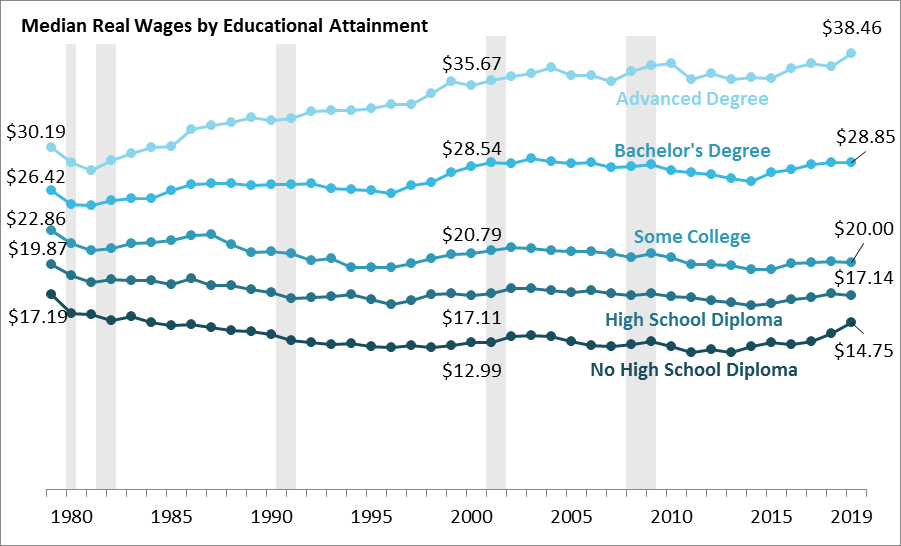
From 1979 to 2019, real wages fell in the 10th, 50th, and 90th percentiles for workers with a high school diploma or less. Meanwhile:
The wage value of a college degree (relative to a high school education) increased markedly over 1979-2000.23 The college wage premium has leveled since that time, but it remains high. High-wage workers, as a group, benefited more from the increased payoff to a college degree because they are the best educated and had the highest gains in educational attainment over the 1979 to 2019 period.24
There are more explanations for this beyond declining union membership, automation, and globalization.
For example, occupational licensing increases. In the 1950s, only about 5% of US workers were covered by occupational licensing. Today, around 29 percent of the workforce requires a license to operate. In their paper, Analyzing the Extent and Influence of Occupational Licensing on the Labor Market, Morris M Kleiner and Alan B. Krueger state in their abstract:
Estimates from the survey indicated that 35% of employees were either licensed or certified by the government and that 29% were licensed. Another 3% stated that all who worked in their job would eventually be required to be certified or licensed, bringing the total that are or eventually must be licensed or certified by the government to 38%. We find that licensing is associated with about 18% higher wages but that the effect of governmental certification on pay is much smaller.
Licensing restricts the number of practitioners, thus restricting supply and bidding up wages for incumbents. The requirements for licensing can be extreme, too, and for jobs where the protection of consumer welfare is negligible at best. In Louisiana, for instance, a cosmetology license requires 1,500 hours of classes and, on average, costs $14,308 to complete. In contrast, half of cosmetologists make less than $19,680 a year.25
And in my home state of Florida:
A 2019 Cato/ YouGov poll found that 45% of welfare recipients reported that the lack of an occupational license had prevented them or someone they knew from getting a job for which they were otherwise qualified.
Self-surveys can be unreliable, but at worst, it supports the notion that extensive licensing requirements greatly hurt low-income, non-college-educated people’s ability to work.
Obama’s administration also weighed in on this problem in their paper Occupational Licensing and Economic Rents:
The importance of an increase in the number of licensed occupations—not just the number of licensed workers—suggests that licensing has expanded considerably into sectors that were not historically associated with it. Figure 6 shows that among licensed workers today, fewer than half are in health care, education, and law—traditionally very highly licensed occupations. Instead, large shares of licensed workers today are in sales, management and even craft sectors like construction and repair.
Non-college-educated workers have also been progressively pushed out of middle-skill jobs in favor of the college-educated. A paper published by the Harvard Business School, Dismissed by Degrees, found that, over the decades, employers increasingly required bachelor’s degrees for jobs that previously didn’t require them. It’s estimated to have affected 6.2 million middle-skill jobs. As an example of how harsh this is for non-bachelor-degree workers: for production supervisors, 67% of postings require a degree, while only 16% of current workers hold one. Two-thirds of employers acknowledged they screened out qualified candidates simply because they lacked degrees. This fell/falls hardest on Black and Hispanic workers, older workers with experience, and “Opportunity Youth” who get locked out of entry-level middle-skill career pathways.
And ironically, the study found that doing this actually hurts employers in the end.26
- Employers reported degree inflation made middle-skills jobs either far more difficult to fill (15%) or difficult to fill (52%).
- 68% of employers reported paying a 11-30% premium for college graduates.
- 59% of employers believed that recent college grads expected higher salaries than non-college graduates (11%). They also perceived that college grads have higher voluntary turnover (39% compared to 21%), are more likely to leave work for a competitor (49% compared to 12%), are more likely to have lower engagement or feel under-utilized (40% compared to 23%), and college graduates were perceived to require slightly more supplementary training and oversight than non-degree workers.
- Companies that reversed degree inflation consistently found hiring for competency and investing in internal training produced more loyal, engaged employees at lower cost.
Immigration is another topic obviously worth discussing.
The ‘lump of labor fallacy’ argument is correct. An immigrant’s relationship to the economy is not zero-sum or purely extractive. They both create businesses and are consumers who add to the economy in the aggregate.
Low-skilled immigrants—both documented and undocumented— are much less violent and less likely to commit crimes than the native population.
However, the economic issue is more multi-dimensional than one-to-one job replacement. And the economic benefits for the working-class population are murky at best.
For instance, George J. Borjas argues immigration hurts native workers’ bargaining power. It is especially bad for high school dropouts, who, by his measures, are disproportionately affected. He estimates that immigration increased the high school dropout labor pool by 55% and lowered weekly earnings by 20%. Undocumented workers are also much more likely (47%) to have less than a high school education than the native population (8%), suggesting a lot of the labor inflation and wage suppression is coming from an illegal source of labor.
More recently, The Congressional Budget Office stated:
The number of people entering the United States increased sharply starting in 2021 and peaked in 2023 before slowing in 2024. That surge in immigration imposed a fiscal burden on state and local governments.
And then:
The surge led to a direct increase in revenues of $10.1 billion, primarily from sales taxes, and a direct increase in spending of $19.3 billion, chiefly for public elementary and secondary education, shelter and related services, and border security. The result was a direct net cost of $9.2 billion in 2023, amounting to 0.3 percent of state and local spending (net of federal grants-in-aid).
A pro-immigration piece makes a point that immigration surplus economic benefits go, “primarily to the owners of capital, which includes business and land-owners and investors.” And:
Research also suggests any negative wage effects are concentrated among low-skilled and not high-skilled workers. Perhaps that is because high-skilled U.S.-born workers are complementary to immigrants to a greater extent than native low-skilled workers, who hold jobs that require less education and fewer language skills.
Another paper states the main beneficiaries of low-skilled immigrant domestic work—childcare, eldercare, cleaning, cooking—are high-skilled women.
The point I’m arriving at is not that anti-immigration stances among the working class are all definitely correct—some may be highly debatable or wrong. The point is that they are not irrational. And when you consider that this class’s median real wages have fallen over the last half century, any perceived threat to their economic self-interest is going to feel outsized to them.27 Feeling largely ignored by leadership on this issue only adds more salt to the wound. It confirms, in their minds, that they are being looked down upon, and it deepens their cultural resentment.
Note: During COVID, wages rose for the working class because the pandemic shifted leverage from employers to workers. Interestingly enough, the exact same thing happened after the Black Death when Europe lost a huge share of its population. Since there was not enough labor to go around, peasants could also demand higher wages. Elites did not accept this willingly, however, and eventually passed the Ordinance of Labourers in 1349 and the Statute of Labourers in 1351, which tried to freeze wages at pre-plague levels and restrict workers from moving around for better pay.
Populism is not a National Problem in the US
The White college-educated population has been moving steadily toward Democratic presidential candidates for almost half a century (bachelor’s degree: 29% in 1980 to 53% in 2020; advanced degrees: 34% in 1980 to 68% in 2020), while the White working class’s movement away from Democratic presidential voting has been much less consistent. However, the White working class has been drifting away from the Democratic Party since the late 60s.
This distinction is very important because working-class Whites didn’t immediately jump from the Democrats to the Republicans. Instead, over the decades, they gradually came to see themselves less as Democrats, with many becoming independents first. Only later did a large bloc of them begin voting more consistently Republican, eventually identifying as Republicans.
The White working-class voting shift toward Trump, then, was less a sudden new movement than the continuation of a longer trend. Wealthy White households voting Republican is also not historically atypical. Them increasingly voting Democratic more recently is, however. Trump may simply have been riding Republican voting trends that had started to become more consistent after 1992.
Trump’s loss in 2020, when White non-college voters shifted slightly left, followed by the shift of minority voters toward the GOP in 2024, only makes me more skeptical that some new, unearthed White working-class movement in 2016 is a good explanation for why Trump won two elections. There’s an argument that Trump activated “embittered” or independent populist voters in key states in 2016 (which the researchers I’m about to introduce refute), but this anti-establishment populist energy is not unique to him; Sanders’s campaign showed that a similar reservoir existed on the Left. Political scientists Noam Lupu and Nicholas Carnes dispel the 2016 ‘populist movement’ myths surrounding Trump’s 2016 win in more detail. The basic conclusion they reach is as follows:
Ultimately, Lupu and Carnes concluded that these key assertions are not only mostly inaccurate, but they distract researchers from discovering the true reasons behind Trump’s 2016 victory and the support he enjoyed among White working-class voters. Lupu and Carnes suspect that these reasons lie in the overall trend they uncovered: since 1992, White working-class voters have increasingly supported Republican candidates, though they are not yet sure why.
“If we’re really going to understand what happened in 2016, we have to understand what happened before that. We need to take a longer view,” Lupu said. “Every election night, we sort of have this idea that everything is completely different. Trump’s election was certainly a more surprising outcome, given that he is a very unconventional politician. But what underlies his victory has been going on for a while.”
Why the White working class went Republican over time is, again, structural. Unlike many European countries, the US has a two-party system and a different voting system. So the White working-class resentment had nowhere to go politically in the US but directionally right. Culturally conservative and economically alienated from the Left, many began to find political information elsewhere. Unions had once provided a political information ecosystem; now Fox News and later alt-media filled that gap.
How Donald Trump Captured the Republican Party in 2016
But why did Trump win the GOP nomination in the first place? It is at this stage that the ‘populist movement’ becomes more important.
The GOP was catastrophically fractured in 2016. 17 serious candidates split the establishment vote up. Trump won 45% of the vote share compared to second-place Cruz’s 25%. So Trump won the GOP nomination by being the single biggest faction.
There is reason to believe that if the establishment Republicans hadn’t underestimated Trump’s appeal in the beginning, they would have consolidated into Cruz’s camp, maybe defeating him.
But they fundamentally misunderstood the underlying reason why many of the White working-class moved right to begin with. Trump tapped into a movement that had been growing for decades. Which is why, by the way, when you look at this graph:
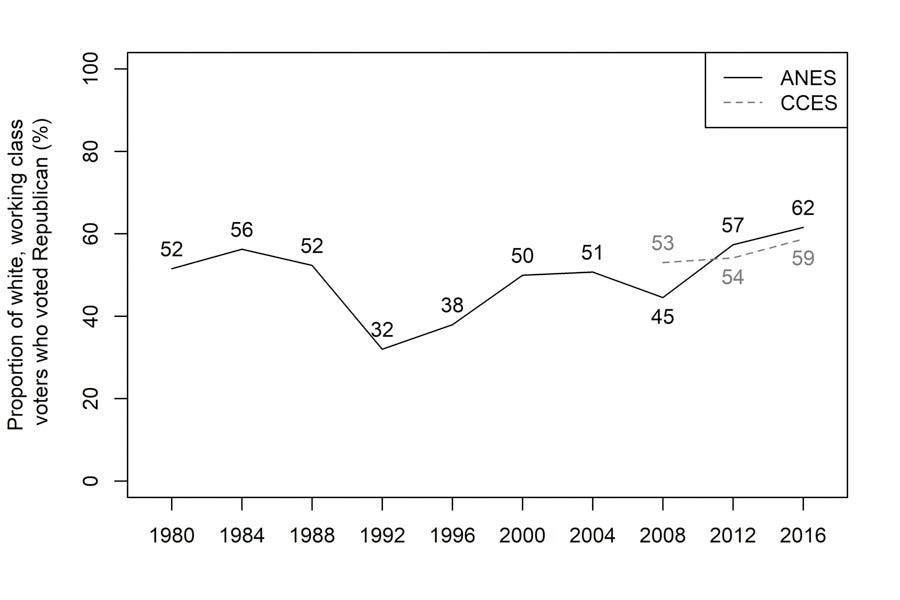
There was a dip in White working-class Republican voter support in 1992. That’s largely because of Ross Perot, a populist nominee.
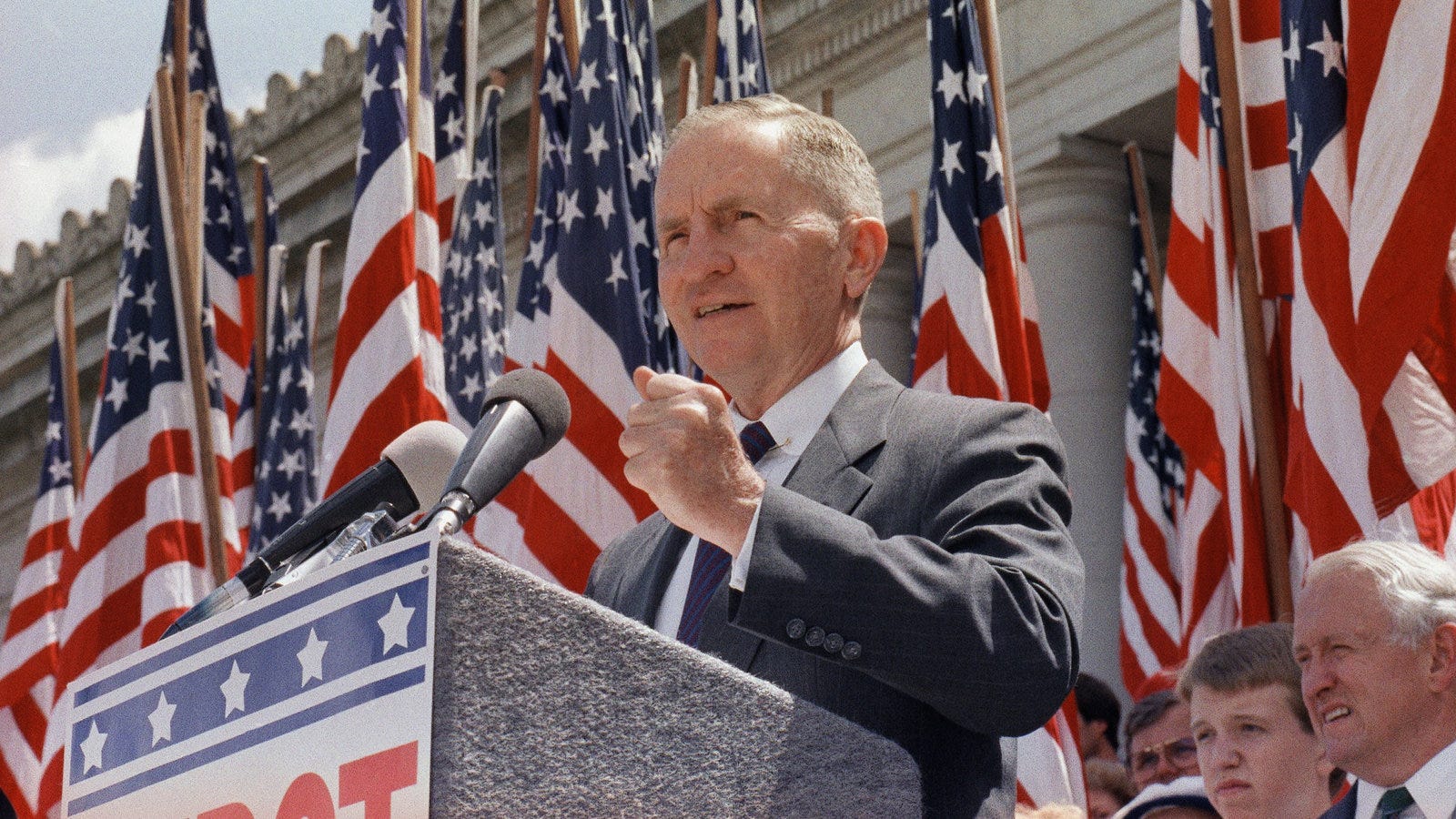
He won 19% (roughly 20 million) of the national vote running as a third-party candidate. It is the largest raw vote total ever won by a non-major-party presidential candidate in US history by a huge margin. Roughly a fifth to a quarter of working-class Whites voted for him.
It’s important to understand populist energy has been available in America since its inception.28 It may very well be an inherent quality of democracies. Trump is a businessman. He found and served the pre-existing demand within the Republican Party.
How Party Primaries Turn Populist Energy into Political Power
The danger of populism in America is not primarily on the national stage but within the parties themselves and specifically in primary elections. It is there that a populist leader can harness latent populist energy to capture a party. Once in control, that leader can use this leverage to force the party’s elites to submit to their leadership (or just replace them) and begin to reshape the party’s culture around their own interests.29
America’s two-party system then magnifies the consequences of this capture because voters are forced to either vote for the populist leader or otherwise defect to the opposing party. If both parties are captured by populists, then a voter basically has no other choice, even if they vehemently disagree with both leaders.
Note: Frances E. Lee’s paper, Populism and the American Party System: Opportunities and Constraints, gives an excellent detailed analysis on populism in the United States. I highly recommend it. One idea I found particularly striking, as it is something I’ve pondered about myself, is that populist movements, despite their major problems, may be cyclical in America and ultimately promote systemic reform.
Even Hofstadter (Reference Hofstadter1955, 18)—who criticizes the nativism, antisemitism, conspiratorial thinking, and other illiberal impulses of late nineteenth- and early twentieth-century Populists—assesses populism as promoting needed reforms and yielding “substantial net value” for American democracy.
The paper also helped to solidify my suspicion that a two party system, when organized properly, is likely a better system than having many competing parties within a nation.
Trump, Elite Self-Interest, and the American Right
By 2030, it is estimated that 14 million preventable deaths will occur in Africa because of USAID defunding. 4.5 million are children under five. These are, and will be, slow, horrific, painful deaths. USAID accounts for only 0.3% of the US budget. Slashing it did nothing to address the budget deficit. Well, to be fair, it did 0.3% of something to fix the budget deficit. And I suppose every dollar counts, right?
When Alexander Hamilton wrote this:
Men of this class, whether the favorites of a king or of a people, have in too many instances abused the confidence they possessed; and assuming the pretext of some public motive, have not scrupled to sacrifice the national tranquillity to personal advantage or personal gratification.
I can find no better single example in 21st-century America than what Elon Musk and the Trump leadership did by slashing USAID, which, despite any pretense by either them or the media, was an act specifically designed to punish the Left for their own personal grievances against them.
The Trump leadership lays bare what history has always warned us about. They reveal what unrestrained self-interest and ambition look like and serve as a powerful example of what makes impersonal, democratic systems so important.
I wish there was something more I could say about this, but almost every action the Trump leadership takes follows this basic pattern. If you want to learn more about the bad things Trump has done, just Google ‘Trump’.
As far as the broader Right goes, they did considerable damage to labor and its bargaining power. They:
- Implemented right-to-work laws.30
- Reagan broke PATCO in 1981.
- They used the NLRB and courts to narrow labor rights.
- They blocked reforms that would have made union organizing easier.
They also threaten to filibuster anytime Democrats try to implement pro-labor policies. And I’m sure there’s much more I’m missing. Throughout the 20th and 21st centuries, they were business-interested, ignorant of, or actively hostile to labor interests.31
Instead, they cultivated (White) working-class cultural rhetoric, passing blame on the liberal elites, taxes, welfare, crime, immigration, bureaucrats, and globalists for the working-class woes.
The new elites of this party have also recently attempted to install their own version of high culture through the “heritage American” movement. It functions as a way to raise White status through biologically inherited European ‘culture’ and ‘roots’, rather than through the post-modern European aesthetic appreciation and adoption on the Left.
However, unlike the Left, this ideology will remain pure and be an egalitarian movement that includes all Whites regardless of stature. Certainly, if it becomes the dominant ideology on the Right, there will never be a time when the elite Whites begin to say, “all heritage Americans are equal, but some heritage Americans have more heritage than others.” That’s never happened in the history of time.
Why Conspiracy Theories Flourish in Populist Movements
Conspiracy theories, though crude, are rarely meaningless. They operate like tales or fables: emotionally impactful and story-like in structure. For example:
“Evil shadow global elites are trying to build a new world order to control us.”
Is more emotionally effective than:
“For the past 50 years, globalization, trade policy, deindustrialization, corporate consolidation, and financialization have hurt my community and made work less stable.”
It creates a villain, moral structure, and direction. It feels immediately actionable. Even if you say them out loud, the first feels to pull outward, while the second feels to pull inward.32
The difference between a tale/fable and a conspiracy theory is that tales and fables are (most often) closed, while conspiracy theories place people in the middle of a story as the specially informed protagonists.
They are incredibly dangerous because they become internalized, the attack surface becomes obscured, the solution becomes simple, and the theory begins to function as a social bonding mechanism and a measure of in-group/out-group membership. A sealed loop is then created, in which the conspiratorial ideology can sustain itself. Even fixing the underlying issue doesn’t necessarily dislodge the theory from the person’s mind. For core believers, any denial is a cover-up, any reform is an admission of guilt or a concession to hide or distract from the “real” problem.
When it comes to the media’s role, I lean strongly toward the “serving demand” camp. Conspiracy theories first grow out of real grievance and fear; the media then identifies that market and feeds it. I’m sure there are strong supply-side dynamics to this as well, like creating a public culture around the theories, forcing in-group non-believers to cooperate or adopt the belief at the risk of being seen as a defector. The media can also help architect the interpretive frameworks through which grievances and fears are filtered, giving people a ready-made conspiratorial lens for making sense of events. But the grievance or fear almost always comes first.
Misinformation is mainly a demand-side problem. People are biased, but they’re not stupid. People’s social feelings, however, are ridiculously perceptive to those around them. If either were not true, you would not be here today.
Social media explains the speed of misinformation’s spread and turnover rate, but not how deeply it penetrates. There is a lot of resentment among the working class in this country. And there were many, many widespread conspiracy theories and misinformation before the internet or social media. Stories from humble origins could still become national legends in due time without the help of any advanced digital media technologies.33 Hopefully, my earlier writings on the anticlerical and flagellant movement—where people literally whipped themselves in public as an act of defiance towards the Church—give you pause from thinking otherwise.
Intra-Elite Competition within Right-Wing Media
Media elites have an interesting dynamic in this relatively new ecosystem. They are ‘enemies’ to the other side and are nominally colleagues with other media elites in their own ideological camp. But in a fractured, cancel-resistant media space, their most direct competition is actually with rivals within their own coalition.
A liberal and conservative media personality serve different markets. A person who regularly listens to Tucker Carlson is unlikely to regularly listen to Sam Seder, except maybe to sneer at him—which, funnily enough, would make those two complementary. So while they attack across political lanes, the true threats to their legitimacy usually come from within.
For example, there is currently a ‘feud’ between Candace Owens and Erica Kirk. Owens has attacked Kirk with bizarre theories in the aftermath of her husband’s death. Kirk is also the CEO of Turning Point USA, an enormous conservative organization. Whether or not it is Owens’s conscious intent (my conspiracy theory is that it is very much her conscious intent), the effect of her attack is to diminish both Kirk’s personal legitimacy and TPUSA’s organizational brand, while simultaneously raising her own.
Media elites, like any product, are also beholden to their market (audience capture). They cannot stray too far from the conspiracy, lest their audience turn on them. Even Trump is not safe from this. Instead, they are forced to compete within their coalition: racing to uncover the next piece of ‘evidence,’ escalating the theory, and using conflict with the opposing party as raw material for new content. Mind, this also naturalizes a moral hierarchy. An elite alt-media host knows the best secrets, notices the most important facts, is the most outraged, and can position themselves as the valiant heroes fighting against the evil elites hurting the people.
Conclusion
The Left is increasingly dominated by the college-educated credentialed class. This is a highly stratified, high-culture, elite party. Certainly, many non-college-educated working-class members still remain within it. But they occupy very, very few of the roles that politically matter. The real stabilizing network is made up of volunteers, activists, politicians, knowledge-class professionals, and other institutional actors, each functioning as a node that helps hold the coalition together. It’s important to remember that widespread coordination isn’t needed to sustain a large coalition; it’s enough for many individuals to pursue overlapping self-interests. And because the knowledge economy is closely associated with high cultural status and has become the dominant economic regime, it signals to younger generations that the “American Dream” now lies within its domain.
The Right, on the other hand, is business-interested first. It supports union busting and, in practice, is generally hostile to labor. Their relationship to the worker class, like the Left, is primarily symbolic. They gesture towards White working-class culture, passing on their own failures to serve this class economically to the Left, immigrants, or ‘radical Leftist ideology’. Trump successfully recognized and captured the populist fervor within the party, using it to win the GOP nomination. He was then able to maneuver through the GOP elite, bring them to heel, and turn his attacks onto the Left.
The problem, then, is that the working class has little to no collective leverage within either party and therefore struggles to exert durable bottom-up pressure. Without a collective foothold, individual workers are fragmented and can’t translate grievances into organized bargaining or coherent political demands, so there is no real force to discipline party elites.
Working-class unions don’t just raise individual workers’ wages. They bind workers together through shared economic incentives and make defection over cultural grievances more costly. But strong unions alone are not enough; they also need direct institutional access to a political party. Otherwise, parties can and will gatekeep the working class out of power.34
To be clear, I am not primarily making an economic argument—though economics is important. What I am arguing is that economics acts as a binding force that makes working-class interests cohesive. It gives workers an incentive to weigh competing priorities: where to push harder, where to concede, and what they risk losing by defecting. Some will still defect, but doing so means risking defeat on every issue rather than bargaining from within a shared bloc.
Institutional access gives the working class leaders beholden to them who can articulate their interests and cannot simply be ignored. If those interests are dismissed, that bloc has the leverage to withhold endorsements, turnout, funding, and candidate selection at a crucial time.35 And importantly, this ultimately creates a downstream working-class culture within a party.
Having internal coalitions with directly opposed material and cultural interests and backgrounds36 also creates a party in which presidents and presidential candidates are then forced to act as uniters, negotiators, and arbiters. It selects for an ideological foundation upon which the president is better prepared to govern in the interests of the people, regardless of the people’s background or stature.
Otherwise, they have too much incentive to govern within narrow ideological windows, while taking outside groups’ interests seriously only to the extent that they need their votes. I do not think it is purely coincidental that every single president selected during the New Deal era before its rupture in 1968 is considered a top-ten president. Men governing under extraordinary circumstances, sure, but lesser presidents surely would have fumbled where they succeeded.
Of course, giving direct access to labor is not without its problems. They, too, will begin to act as a coercive coalition trying to force their interests. But they must be given a standing to be contested rather than ignored. It’s worth repeating: it is through conflict, shared collective interest, and fear of defection that both elites and the working class are properly regulated.
This does not mean that populism will be fully ‘cured’ in America.37 There will always be people with grievances in any society. Modern societies are too complex to satisfy every individual demand. But granting labor institutional access helps prevent those grievances from hardening into widespread, latent populist energy by providing workers with an organized channel for political pressure. When that channel breaks down or does not exist, political energy is instead channeled toward personalities and symbolic gestures.
Despite the inefficiencies that come with collective labor, unchecked elite self-interest and rent-seeking, national instability, and, especially, populist leaders, should be seen as costs a nation bears, both economically and politically, from being institutionally ignorant of the working class.38 And because of Trump, political elites, both Left and Right, are now well aware of the power that comes from capturing populist energy in their respective parties. The Right has also built a political culture around populism, which makes the danger more durable than Trump himself. My worry is that a more skilled political actor could harness the same forces with greater discipline and do considerably more damage to our institutions. And if the 2008 financial crisis was not enough, a corroded, crippled system might be the only way for this structural problem America faces to be taken seriously.
But if either party is serious about addressing populism or helping the working class, they have to start by finding ways to give workers real autonomous leverage within their institutions again. Every other gesture towards them is little more than window dressing.
Footnotes
- It’s probably more correct to say the Civil Rights was the true moment we fully transitioned. ↩
- As I argue later, knowledge-economy elites appear to be doing precisely this through licensing restrictions and credentialed gatekeeping (in association with business owners). Though, this does not mean it is done through a conscious coordinated effort. As I’ve been adamant about repeating throughout this essay, it just merely takes many, many instances of individuals pursuing overlapping incentives for a widespread effect to take place. ↩
- Meaning within a complex, competitive market economy. ↩
- I’m half Korean, so North Korea gets extra special shoutouts. However, unfortunately, I’m a Park, not a Kim. ↩
- They still make higher annual salaries in comparison to most Americans. ↩
- There are obviously other signals beyond just language though. ↩
- Excommunication also meant that aggrieved barons could claim they were released from their oaths of fealty, allowing them to oppose King John politically while using theology as cover. ↩
- Though this divergence or ‘breaking’ has been happening for a while now, it is not a phenomenon strictly tied to the 21st century; it just became visually acute during the Great Recession. ↩
- Counter elites also amplify issues or failings in pursuit of their own ambitions. ↩
- Obviously, many were forced upon them by the Trump Administration and were bad—like with DOGE. Others found a path to reform alongside the broader shift in national culture. ↩
- They should still continue to reform, though, our institutions are important. ↩
- Later merged into the AFL-CIO in 1955. ↩
- This rule was beneficial to union leaders (and other internal factions) because they only needed to persuade a majority of delegates (51%) in a state to support a candidate to win all the delegates in that state, thereby making their influence and leverage that much more powerful at the national convention. ↩
- The true full sentence is: “This confirmation in all but name that state parties now needed to meet numerical quotas for African Americans, women, and youth sparked an intractable debate.” The debate was that, if the purpose of the reforms was to empower individual voters, requiring delegations to be demographically representative contradicted those voters’ freedom to choose whomever they wanted as delegates. ↩
- However, as we’ll see in a moment, the new delegates very much wanted to return power back to themselves by unbinding themselves. ↩
- The caucus path was more beneficial to union leaders because it allowed them to organize and more durably campaign for their chosen candidates. ↩
- There is a robust literature on this in the fields of investment, savings, and medicine. What these studies generally show is that, because of the unusual complexity of financial and medical decisions—and the enormous information asymmetry between consumers and providers—people often make naive, poorly informed, or highly inefficient choices without appropriate institutional structure and choice architecture. In many cases, they make no active choice at all, instead following defaults or remaining inert. I would argue that politics, and primaries in particular, present an even more difficult environment for a voter to reason within. And as I’ll show later, it was this exact problem that Trump exploited to capture the GOP. ↩
- It could be argued that this could have allowed labor to reinsert itself into the old arrangement had it came to pass. ↩
- Effectively reinstating the pre-McGovern-Fraser structure…
But to be fair it became more of a hybrid structure that still maintained the primary leverage given to the state primary and caucus voters. ↩ - The system was reformed again after the contentious 2016 Democratic primary, reducing superdelegates’ power in the nominating process. ↩
- To put a label on it: the current arrangement on the Left has reached a ‘self-reinforcing institutional equilibrium’. Entry requires adoption and has strong selection effects and the working-class individuals are dispersed and face collective action problems to exert power. The value of belonging rises because it is the dominant economic engine in the US and signals high cultural status, thereby making the cost of individual defection extremely high. ↩
- Demos.org has a more detailed look at defining ‘working class’ if you’d like to read their description on it. They come to the same determination that education, despite its imperfections, is the best proxy for working class citizens. ↩
- Employee benefits generally move in the same direction as wages. Non-college graduates also have higher unemployment rates than college graduates (2.2% college graduates , 3.3% some college, 3.7% high school diploma, 5.4% no high school diploma). ↩
- I have a theory as to why wages for the college-educated stagnated after 2000 that has to do with the decline of unions and organized labor’s political strength. But I would prefer to save that for the more explicitly opinionated follow-up I want to write, as it takes us too far off track here. You might be able to guess what it is, though. ↩
- This also creates a stabilized rent-seeking network between cosmetology schools, incumbents, licensing boards and professional associations that require government intervention to break up. ↩
- Which if you’re catching the economical subtext I’m laying down, it means a much less efficient economy. ↩
- This is why, by the way, inflation and the cost of living became the defining economic issues for working-class voters in 2024. ↩
- But it is incredibly important to understand that there is no singular populist “bloc.” These groups may converge at times, but the many individuals who make up a left-wing or independent populist movement are not identical or interchangeable to the many individuals that make up a right-wing populist movement. Independent populist candidates like Perot may temporarily bring together disaffected voters from across the political spectrum, but the American electoral system gives them little chance of winning or building a durable national party. It is also more accurate to say populist energy is always available within a democracy. All throughout our history, there was a form of populist ↩
- I do believe it is somewhat harder for a populist leader to fully capture the Left (but far from impossible) because of the earlier discussed mesh network and institutional ‘weight’ that exists on the Left. But this is also why the Left may be more readily available to a New Deal–like populist movement, if it is pursued very carefully. Even so, given the current state of private sector unions and the party’s existing institutional arrangement, accomplishing this on the Left would require an extraordinary effort. ↩
- Which interestingly shows that even while union power was institutionally strong, it did not mean it was absolute or couldn’t be challenged. ↩
- Elites on the Right also include many knowledge-economy professionals. But many more credentialed elites have increasingly moved toward the Left, while the Right contains a comparatively larger share of business owners, entrepreneurs, and more conservative corporate executives. I don’t mean this to be taken as saying that being more pro-business is inherently bad, by the way. Like all things, it just needs to be properly balanced. ↩
- The other reason conspiracy theories place the fault on a consciously coordinated effort is that, over time, localized, unconscious, overlapping incentive pursuit genuinely begins to look like it is. ↩
- Or really any media technology at all. Some stories and tales spread throughout an entire country just through oral tradition alone. ↩
- This can be done cynically or just because entry today is so complex that a working-class individual doesn’t have the time, resources, or connections to enter into politics (as this paper describes in further detail). It also cannot be overstated that a genuinely working-class individual entering this arena—regardless of race—would be alienated amongst a highly affluent professional class, even if they had a résumé just as strong and an equally legitimate claim to be there. ↩
- This essay has already become (much, much) longer than I thought it would, so writing about the optimal delegate arrangement today would be too much. I do think the New Deal arrangement, despite its flaws, was superior, but it is something worth thinking about more deeply and returning to in a later essay. ↩
- Not just ideologically opposed. There are important differences between a knowledge economy elite who cares about labor and a working-class citizen who cares about labor. ↩
- Again, especially because there isn’t a single populist “bloc” in America. ↩
- And again, I will save the details of this argument for my opinion piece, but I don’t think maintaining labor political power would merely have meant accepting one set of inefficiencies for another. I think it would, in fact, have created a more robust, diverse, and efficient economy. I also just gave away what my theory was in footnote 24. Oops. ↩
Leave a Reply