Part one of a series on the Russian Revolution, the rise of Nazism, and the New Deal.
Russian Serfdom
Serfdom can most aptly defined as a coercive legal relationship between a landowner/estate and a peasant. Distinct from slavery1, there was no single institution or legislative piece that legitimized serfdom in Russia. Instead, it was an accumulative process that solidified over the centuries, gradually restricting the rights of peasants in favor of the landowners. These restrictions meant that serfs generally could not move, marry, or work for another master without their own master’s consent.
The serfs represented a huge segment of the Russian population. As Yale Law School Rare Book Librarian Michael Widener describes:
Out of a population of 67 million persons (1858-59 census), some 23 million were serfs.
There were two principle economic arrangements of serfdom; the barshchina and obrok. The barshchina serfs owned land but paid rents to their master in the form of unpaid labor. The obrok serfs paid rents more directly in the form of goods or money. This arrangement generally allowed for more freedom as obrok serfs had greater control over how they fulfilled their obligations.
The arrangement of obrok and barshchina was also highly geographical and fluid, but over time, barshchina increasingly consolidated around agricultural centers.
By the last third of the eighteenth century, it [barshchina] was increasingly associated with the rich black soils of the seven Central Agricultural provinces south of Moscow. Only 45 percent of the serfs were subject to labor service in the thirteen nonblack soil provinces, where soils were poor and the climate harsh, but the rate was 74 percent in the Central Agricultural Region. By the middle of the nineteenth century, labor dues were at their highest in Ukraine and New Russia, where 97 to 99.9 percent of the male serfs owed barshchina to produce grain for the European market.2
The Landowners
Originally there were two major kinds of noble landholding; the votchina and the pomestie.
The votchina (which literally translates to patrimony) can be thought of as hereditary family property.
In the eleventh through thirteenth centuries, the term mainly indicated the hereditary rights of princes to their principalities or appanages. Thus, according to Nestor’s chronicle, the princes who gathered at Lyubech in 1097 proclaimed: “Let everybody hold his own patrimony (otchina ).” It was in this sense that Ivan III later applied the word votchina to all the Russian lands claiming the legacy of his ancestors, the Kievan princes.
The pomestie, on the other hand, were grants of land made by the emperor in exchange for loyal service, beginning in the late fifteenth century. The state needed cavalrymen, administrators, and military servants but did not have the funds to pay them a substantial salary. So instead, land was given to the pomestie in exchange for military service.
Overtime, the votchina and pomestie began to resemble one another greatly.
as Vladimir Kobrin points out, pomestie from the very beginning tended to become hereditary property; on the other hand, the owners of patrimonies were obliged to serve in the tsarist army (legally, since 1556), just as pomestie holders did. S. B. Veselovskii cites some cases from the 1580s, when the authorities ordered the confiscation of both pomestia (pl.) and votchiny (pl.) of those servicemen who had ignored the military summons.
Despite this, Mikhail M. Krom notes that the votchina maintained its status above the pomestie and formed the basis of the 16th and 17th century aristocracy.
Nobles were not just given land in the wilderness as this would be economically useless without huge investments. Instead they were given productive land populated by peasants cultivating it. As mentioned above, these peasants were made to pay rents to the landlords and overtime became increasingly more attached to their locality and landlords.
Peter the Great’s 1714 Decree on Single Inheritance effectively merged the votchina and pomestie systems. Then, in 1762, Peter III abolished mandatory state service for the nobility, while Catherine II’s Charter to the Nobility of 1785 further consolidated the nobility’s power over their land. From the Encyclopedia of Russian History:
Isabel de Madariaga (1990) accurately breaks down the rights by category. In terms of personal rights, the Charter guaranteed the nobles trial by their peers, no corporal punishment, freedom from the poll tax, freedom from compulsory army duty, the right to travel abroad, and the right to enter foreign service. (This is a partial list.) Property rights were enhanced by allowing the nobles to exploit their mineral and forest resources. Manufacturing on their own land was permitted and the right to purchase serfs was reinforced. As for corporate rights, the nobility's rights of assembly were solidified and they were given the privilege of directly petitioning the empress. Historically, the upper nobility exercised this right anyway, whether it was written or not.
The Crimean War
There seems to be unanimous agreement among imperial Russian historians that Russia’s humiliation during the Crimean War was directly responsible for the emancipation in 1861.
This does not mean that the idea of emancipating the serfs suddenly occurred to Russia in 1861 following the war. Emancipation had been discussed throughout the country for decades before the conflict. The war was simply the event that finally set emancipation into motion. As we will see in a later essay—and as I have already discussed in a previous essay—this was not so different from America’s own emancipatory path. The immorality of slavery had been fiercely debated since the nation’s founding, but it was ultimately the expansion of slavery that served as the catalyst for the Civil War and, in turn, the Emancipation Proclamation.
By all measures, Russia was seen as one of the great military powers in the world by the time of the Crimean War. They had an extraordinary military record particularly in the face of Napoleon, and the soldiers were viewed as fierce combatants. What was suddenly exposed in their loss, then, was the archaic nature of their autocratic government. American historian, Paul Bushkovitch puts it quite succinctly:
It was the autocracy that was defeated, all the more so because the long siege of Sevastopol demonstrated to many Russians that the army still had the spirit to fight, a spirit hampered by the backwardness of society and government.
and then:
The greatest problem was that the world was changing very quickly in the middle years of the nineteenth century, and the most rapid changes were taking place in Great Britain, Russia's primary imperial rival. Railroads were transforming the landscape in all of Western Europe and the United States, building on and stimulating the rapid modernization of iron and steel production, thereby raising output to new heights.
Amusingly, this antiquated governmental system was often seen by conservatives and Slavophiles as evidence of Russia’s spiritual superiority over Western Europe. My favorite author, Dostoevsky, fell prey to this very trap. He was himself a Slavophile (later in life) and believed in the tsar.3
Autocratic Russia had incredibly weak infrastructure, marred by terrible transportation systems. This meant that even though the war was being fought in their own backyard, the Russians had greater difficulty transporting soldiers and supplies by land than Britain did by sea.
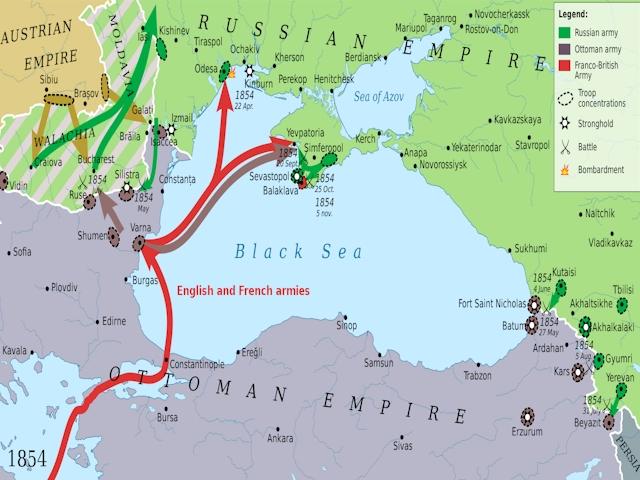
Russia’s humiliating logistical defeat exposed just how badly the empire had fallen behind the rapidly industrializing Western powers. Without reform, Russia risked becoming irrelevant in the face of the Western world’s accelerating industrialization.4 Drastic change was therefore required.
The Emancipation of the Serfs in 1861
Because serfs were intrinsically tied to their estates, removing them from the land and placing them in long term military service carried significant social and economic costs, contributing to a highly inefficient military system.
Mid-19th century warfare required large reserve forces that could be called up in an emergency. (Having reserves reduced the cost of the standing army.) Serfdom constrained Russia's ability to maintain a large reserve force. As Moon noted: ‘the main reason why serfdom was abolished was the same as the reason why it had been introduced: in the interest of supporting Russia's armed forces’.5
Thus freeing the serfs was one of the first necessary steps Russia had to take to update their military capabilities to match the modern world. Serfdom also constrained labor mobility and created weak economic incentive structures for serfs.6
We document substantial increases in agricultural productivity, industrial output, and peasants' nutrition in Imperial Russia as a result of the abolition of serfdom in 1861. Before the emancipation, provinces where serfs constituted the majority of agricultural laborers lagged behind provinces that primarily relied on free labor. The emancipation led to a significant but partial catch up. Better incentives of peasants resulting from the cessation of ratchet effect were a likely mechanism behind a relatively fast positive effect of reform on agricultural productivity.7
Grievances
After emancipation, the former serfs received much smaller allotments of land than they had been accustomed to under serfdom. On top of this, they were required to make redemption payments8 to the government for their newly allotted land. Heavy taxes and growing “land hunger,” exacerbated by rapid population growth in rural Russia, further impoverished the peasantry.9
And while the landowners had a legal claim to the land, the peasants believed they had a moral or customary claim to it. For generations, they had cultivated the land, cared for its livestock, and depended on it for their survival. Because of this, they felt entitled to a share of it.
This belief was reinforced by the communal village system through which peasants experienced their relationship to land. Under serfdom, nobles legally owned the land on which peasants lived and worked, but the peasant commune often allocated the villagers’ agricultural land among households and distributed certain collective obligations. In everyday life, then, most peasants were far more intimately connected to this communal system than to the nobleman’s legal ownership of the estate.
Once the serfs were emancipated, the state allocated land to village communes rather than directly to individual households. In this sense, much of the peasants’ everyday relationship to the land remained continuous after 1861. What changed however, is that the village commune was strengthened and the land under its control was now legally recognized by the state.
Communes were collectively responsible for redemption payments, so if a household left, the remaining households could be forced to make up its share of the obligation. To prevent this, communes often restricted the movement of their members. Now, instead of being tied to the landlords, the peasants were tied to the commune, though it would be a mistake to draw a one-to-one comparison between serfdom and post-emancipation communal life.10
As a final note, older Marxist literature often exaggerates the degree of stratification that emerged among the peasantry after emancipation. The peasants did become increasingly less economically homogeneous, but the level of differentiation was by no means exceptional for the period.
On the eve of military defeat and the 1905 Revolution, Russian income inequality was middling by the standards of that era, and less severe than is inequality today in China, the United States, and Russia itself.11
And even if inequality had risen, the peasants’ standard of living and access to markets increased absolutely after emancipation, meaning that even the poorest peasants were generally better off than before.
Land was indeed primarily an economic question, but not simply as a material asset in the way we tend to think of it today. For the peasant, land meant status, food, income, livestock, inheritance, culture, and independence. A lack of land therefore constrained a peasant’s ability to pursue their own interests, regardless of their income or economic standing.
Rupture in 1905
The peasants were personally free after emancipation, but without proper land allotment, they were still heavily dependent on the noblemen for land; land they believed they had an intrinsic right to in the first place.12
On the other hand, the nobility claimed a hereditary and legal right to their vast estates and had, for decades, received concessions from the state that steadily consolidated their power, only to have the rug pulled out from under them with emancipation.
Thus, an enormous problem emerged for the tsarist government, one for which it had no adequate answer. Chaos began to spread across rural Russia reaching a peak in 1905.
the great majority of [peasant] incidents (about 75 %) involved conflicts between the peasants and the gentry landowners; the conflicts with state officials, police and troops (about 15%) usually developed as a consequence of their intervention in the movement against the landowners.13
And the problem did not end in the countryside. Urban workers were deeply dissatisfied with their working conditions and increasingly went on strike across the country, disrupting industry and further destabilizing the empire.
Mutinies also began to break out within the military which was overwhelmingly composed of peasants. The most famous instance being the Battleship Potemkin mutiny in June 1905. This was especially alarming for the state because, without a loyal military, its ability to enforce authority was severely weakened.

It is important to understand that there was no uniform ideology among the peasantry. They were neither fully individualist nor socialist, and their views varied considerably depending on a range of factors. It is better to view the actions of the peasantry during this period as fundamentally pragmatic. From this perspective, there is no contradiction in a peasant both wanting an individual plot of land while still preferring the communal village arrangement for shared resources and social belonging. What was broadly uniform across the peasantry, however, was that they felt they did not have enough land.
The tsarist government was forced to make concessions to the peasants in response to unrest across the country, especially as its revolutionary opponents were competing for the peasants’ support.14 A decree of November 3, 1905 provided for the final elimination of the peasants' redemption debts by January 1, 1907. Pyotr Stolypin became the prime minister in July of 1906 and his decree of November 9, 1906 allowed peasants to lay claim to individual ownership over property previously held by the commune.
The hope was that giving peasants greater individual ownership over their land would create stronger incentives for investment and productivity. Stolypin also hoped that private ownership would make any potential revolution more costly for the peasants themselves. His reforms certainly helped dampen some of the revolutionary energy in the countryside. For instance, the state underestimated just how many peasants were willing to quit their commune in favor of private enclosures.
But even so, Stolypin’s reforms failed to achieve their ultimate goal of creating a peasantry ideologically committed to private property. They viewed their own private property, which remember, was tied to cultivation, as distinct from the noble’s huge estates. Thus the fracture remained, leaving the peasantry politically open for capture.
In many ways, Stolypin’s political theory was sound. Perhaps, over time, greater reliance on individual private property rights might have weakened the peasantry’s revolutionary fervor enough to blunt the appeal of revolution. But, as we know, history did not unfold that way. In 1911, Stolypin was assassinated by a revolutionary, and then, in 1914, came World War I, mobilizing millions of peasant men, disrupting Russia’s political and economic systems, crescendoing into imperial and military collapse in 1917.
The peasant story, of course, does not end here. But it is impossible to continue without first delving into the history of the growing friction between the state and the revolutionaries, which will be the focus of my second essay on the Russian Revolution.
For example, serfs were still legal persons whereas slaves were directly viewed as property.
Elvira M. Wilbur, “Barshchina,” in Encyclopedia of Russian History, ed. James R. Millar (New York: Macmillan Reference USA, 2004), Encyclopedia.com, accessed September 22, 2026, https://www.encyclopedia.com/history/encyclopedias-almanacs-transcripts-and-maps/barshchina.
His profound understanding of human beings allowed him to transcend this belief in many of his novels, but this ideology can nonetheless be found throughout his work.
At best. At worst, it meant being eventually conquered by a superior nation.
Michael Ellman, “Russia as a Great Power: From 1815 to the Present Day Part 1,” Journal of Institutional Economics 19, no. 1 (2023): 1–17, https://doi.org/10.1017/S1744137422000273.
It is necessary to note that Marxist literature overestimated the
Andrei Markevich and Ekaterina Zhuravskaya, “The Economic Effects of the Abolition of Serfdom: Evidence from the Russian Empire,” American Economic Review 108, nos. 4–5 (2018): 1074–1117, https://doi.org/10.1257/aer.20160144.
Redemption payments were payments made by the communes to the government to reimburse the state for compensating landowners for the land allotted to the peasants.
Maureen Perrie, “The Peasant Movement of 1902,” in The Agrarian Policy of the Russian Socialist-Revolutionary Party: From Its Origins through the Revolution of 1905–1907 (Cambridge: Cambridge University Press, 1977), chap. 6, published online October 7, 2011, https://doi.org/10.1017/CBO9780511896354.010.
A. Delano DuGarm, “Redemption Payments,” Encyclopedia of Russian History, Encyclopedia.com, accessed September 24, 2026, https://www.encyclopedia.com/history/encyclopedias-almanacs-transcripts-and-maps/redemption-payments.
Peter H. Lindert and Steven Nafziger, “Russian Inequality on the Eve of Revolution,” The Journal of Economic History 74, no. 3 (September 2014): 767–798, https://doi.org/10.1017/S002205071400059X.
Communes also gave peasants a vehicle for collective action. They became largely autonomous bodies that elected their own officials and could collectively resist state coercion.
Maureen Perrie, “The Nature of the Peasant Movement,” in The Agrarian Policy of the Russian Socialist-Revolutionary Party: From its Origins through the Revolution of 1905–1907 (Cambridge: Cambridge University Press, 1977), 118–140, https://doi.org/10.1017/CBO9780511896354.015
But again, it is extremely important to understand that, at this time, the peasants were not firmly aligned with any single political party.