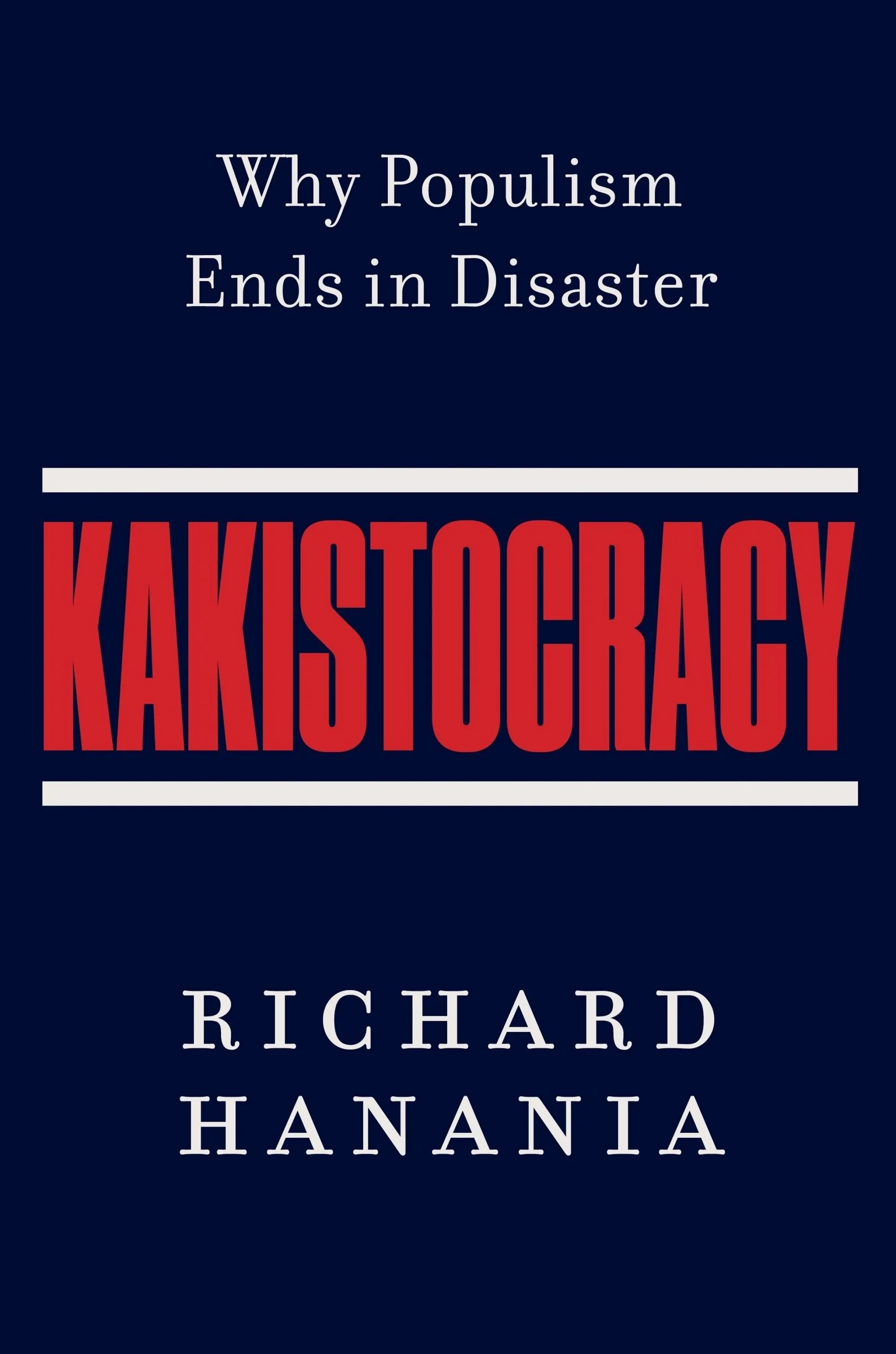
A response to Tibor Rutar’s review of Richard Hanania’s Kakistocracy, arguing that social media cannot explain America’s recurring populist movements.
A few things I want to lay out before going through my rebuttal:
- I read both Tibor Rutar and Richard Hanania quite a bit and think they are both intelligent people and have many good takes, so I do not mean this to come off as a ‘takedown’ essay. I still think Hanania’s book is probably useful even if its social media explanation is incorrect.
- I have not read Hanania’s Kakistocracy and so am basing my review on Tibor Rutar’s review of his book. I have no doubt that the research Hanania goes through in the book is both thorough and probably correct. My issue is not about bad research but specifically that Rutar’s (and the book’s) social media argument is not a good explanation for populism today. If it comes to be that there is something I misrepresent about this specific argument, please let me know, as I’d be more than happy to be corrected. But I recently saw Hanania praising Rutar’s review so I’m even more inclined to believe I am not.
- I am writing specifically about populism in the United States because that is where I understand it best, but this is likely just as relevant across the broader Western world.
Social Media is not a good explanation for populism today.
Hanania’s explanation for populism, as Rutar states, is:
Hanania’s preferred explanation is basically communications technology. That might sound too simple, but I think it’s actually right. In fact, I’m convinced that any explanation of populism that doesn’t put changes in the information ecosystem front and center is not really trying to explain the phenomenon.
And then Rutar expands upon this to say:
Unfortunately, the internet, podcasts, YouTube, X, TikTok, and the rest of the decentralized media ecosystem have made it possible for anyone to reach a mass audience directly.
But the glaring issue with this explanation is that it ignores the huge populist movements that have been happening throughout America’s entire history without the aid of any social media whatsoever.
For example, following the Civil War, it was a large populist movement that challenged and drove fear into the elite Southern Democrats. Many of the movement’s constituents were poor Whites and formerly enslaved Blacks who were either illiterate or possessed only basic literacy skills, meaning that print-based communication technologies would have had limited reach among them. Teddy Roosevelt’s 1912 Bull Moose Party was in many many ways, a populist party. Robert La Follette ran as a progressive populist in 1924, winning 16.6% of the national vote. Before his assassination in 1935, Huey P Long was potentially a very serious national populist rival to FDR. The New Deal coalition itself contained many people who would be described as populists. George Wallace ran as a segregationist racial populist in 1968 and won 13.5% of the national vote while also winning 5 of the ‘Solid South’ states. Then he ran again through the Democratic Party in 1972 and received 23.17% of the national Democratic vote, in second place behind Hubert Humphrey’s 25.42%, while also placing second in delegate wins (though far behind George McGovern) through the primary and caucus process. Ross Perot captured 19% of the national vote (20 million) in 1992 as a third-party populist, despite the absence of any major national crisis beyond widespread dissatisfaction with the political establishment.1 Ross Perot was also a billionaire like Trump. In 1992, the establishment was still very much in control of the media. Fox News didn’t even exist yet. How would social media account for this?
If by communications technology, Hanania and Rutar mean television, radio, books, newspapers, magazines, or literally any technology related to communication, then I agree with them. The invention of Gutenberg’s printing press in the mid-15th century was a major reason the anti-clerical and anti-institutional movement against the Church became so widespread.
I mean, my God, Wikipedia’s own summary of the Roman Catholic Church’s reaction to the Protestant Reformation movement literally sounds like it was written for 2020s America:
Unlike the Protestants who targeted the masses through printed works in the vernacular of the people, Roman Catholic propagandists targeted influential people such as priests who preached to their congregations on a weekly basis. Thus with fewer works they reached large Catholic audiences.
Although the Roman Catholic propagandists did put forth some effective propaganda campaigns, primarily the campaign against Luther regarding the Peasants War, they neglected to get their message across to the general public. They failed to capitalize in the ways that the Protestant propagandists were able to; they did not commonly produce works in the vernacular of the people, which had been an effective tactic for Protestants. Also Roman Catholic publications, either in German or Latin, produced during the reformation years were greatly outnumbered by the Protestants. The sheer volume of Protestant publications made it impossible for the Roman Catholic propagandists to quell the Protestant ideas and doctrine that transformed religious thought and doctrine in the sixteenth century.
With this in mind, should I take Rutar’s earlier statement to mean that literally any change to the information technological landscape should be front and center when discussing populism? If so, that’s fine, but I must ask, what is the point of such an argument?
And though it’s separate from my main argument, I’m not even entirely convinced of Hanania’s argument that populism, while useful at times in undeveloped nations, is ultimately a destructive force here in the US2 (mind, again, I’m extracting this from Rutar’s review but Kakistocracy’s subtitle, “Why Populism Ends in Disaster” basically says this outright anyway). It’s not something I really want to get into here, but I’ll leave you with this:
Even Hofstadter (Reference Hofstadter1955, 18)—who criticizes the nativism, antisemitism, conspiratorial thinking, and other illiberal impulses of late nineteenth- and early twentieth-century Populists—assesses populism as promoting needed reforms and yielding “substantial net value” for American democracy. Rather than a danger to democratic institutions, populism in the United States is instead seen as a rhetorical tradition operating within the confines of normal partisan (Gerring Reference Gerring1998) or presidential politics (Azari Reference Azari2017; Bimes and Mulroy Reference Bimes and Mulroy2004; Bonikowski and Gidron Reference Bonikowski and Gidron2015).
To steel-man Hanania’s argument, populist leaders are definitely very dangerous and pose serious threats to liberal democracies. But the problem of populist leaders has more to do with structural flaws in the U.S. primary system and should be discussed separately from populism itself. Although the two are understandably conflated, they represent distinct problems.3
What is the explanation then?
The explanation is that there is always latent populist energy within democracies. It may even be inherent to any society, functioning as a mechanism to counteract elite power/rent-seeking.4
There is a reason why there has always been cultural demand and creation for anti-establishment, anti-elite, populist media like Spartacus, The Octopus, Network, Rollerball, The Running Man, Total Recall, One Flew Over the Cuckoo’s Nest, Resident Evil, Braveheart, The Iron Heel, Catch-22, ROBIN HOOD, Fight Club5, RoboCop, Metal Gear Solid, The Grapes of Wrath, First Blood, V for Vendetta, A BUG’S LIFE, The Matrix, The Hunger Games, Cyberpunk 2077, Final Fantasy VI, VII, and X and I could go on and on, and on.6 Why would it be any different for political appetite then?
Therefore, recent changes in communications technology are not needed to explain the existence of the current populist movement, any more than they are needed to explain the major populist movements that preceded it.7 I do think there are structural problems within the US system that need to be addressed to ‘solve’ for populism, but communications technology are certainly not front and center in that solution.
Footnotes
- There was a mild recession in 1990 and 1991, but if that’s all it takes to cause a huge populist movement, it only reinforces my argument. ↩
- He does note that the American (populist I’m assuming) Right called out overly aggressive COVID restrictions and DEI quotas. But this, in my opinion, is just a microcosm of the larger function of populism historically. ↩
- You don’t necessarily need to solve for populism to solve for populist leaders in America, but the solution to populism is related to the solve for populist leaders. ↩
- I guess I did get into it here. But this really does deserve its own post, as there is much more to the argument, and I would like to further flesh out what I mean by “populism.” There are many different dynamics at play when we talk about populists, laypeople, or the masses, and those dynamics shift depending on the structure of society. ↩
- Some of these like Fight Club and Network also show how these movements can themselves become authoritarian. ↩
- I could even make an entire (even if crude) argument as to why capitalism itself is a populist economic structure. ↩
- I don’t want to just rip on Tibor Rutar, as again, he is obviously very smart and has many, many good insights, but statements like:
Unfortunately, the internet, podcasts, YouTube, X, TikTok, and the rest of the decentralized media ecosystem have made it possible for anyone to reach a mass audience directly. In many ways, this can be cool. For one thing, I wouldn’t have this Substack before the internet.
Do not look good when he is simultaneously planting his flag down on a highly reductionist claim that, at worst, is simply incorrect.
Even worse are takes by Benthom’s Bulldog like:
Does anyone believe that Christopher Wray—from Yale Law School no less—is less qualified than Kash Patel? Patel got his JD from Pace University, “which is not ranked among the top hundred law schools in the country and whose incoming students currently have a median LSAT score that is at the fiftieth percentile of all test takers.”
Kash Patel is bad because he’s bad, not because he went to a school ‘not ranked among the top hundred law schools in the country’. Trump selected him because he is a Trump sycophant. If Christopher Wray was a Trump sycophant, I’m sure Trump wouldn’t have got rid of him. So why even bring up the education aspect?
Many people who went to elite universities have many bad ideas and are wrong about many things. I’m sure that if I flashed a picture of Ben Shapiro right now, who earned his JD from Harvard, many people on this site would agree.
Heidegger wrote one of the most influential philosophy books of all time and was a Nazi. Lincoln’s formal education amounted to less than a year in total and was largely self-taught. The slaveholding class explicitly used this fact against him while he was campaigning. I mean, c’mon. ↩